Next year’s London Marathon will see a major change as a two-day event in 2027 and now organizers are considering a mixed field that would allow the elite women to start alongside male runners and utilize pacemakers.
In a report on Wednesday in The Independent, London Marathon Events CEO Hugh Brasher said he was “prepared” to push beyond women’s only records at the race and ultimately produce faster times.
“Will London, in the future, have a women’s only record? Yes, I think that’s important,” Brasher said. “However, in the past, we’ve played around with it. Paula [Radcliffe], when she ran 2:15, had the women’s only record, so there were men running around her. She probably says they didn’t help her at all.”
Brasher said that his team regularly talks to the elite athletes about their goals for the year and leading into his race. Breaking past the women-only record and producing better times would be among the top reasons for having a mixed field and letting the athletes choose male pacers.
The last time male pacemakers joined the elite women’s race was 20 years ago, when Deena Kastor bolted to a 2:19:36 win.
But three years prior, Paula Radcliffe broke the women’s world record in 2:15:25 in 2003, a mark that has been difficult to lower with significantly faster performances. The race format switched to women’s-only race starts after Kastor’s mark, which was also an American record at the time.
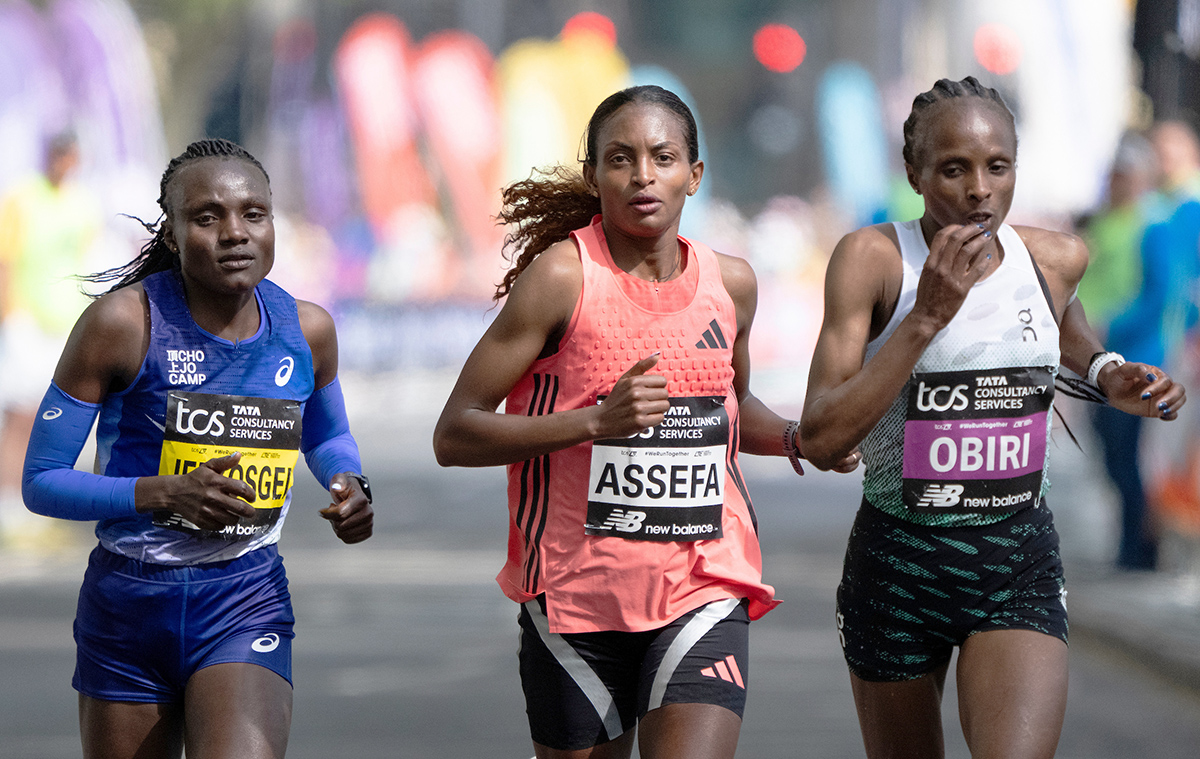
Tigst Assefa is among the top women who have routinely challenged the bounds of London, clocking women’s-only world record of 2:15:50 and 2:15:41 in 2025 and in April. And Brasher sees her as a likely candidate to take down the current world record by Ruth Chepngetich, who stormed to a 2:09:56 at the Chicago Marathon in 2024.
“I think what Tigst did in Berlin, it was a tragedy, in terms of the injury she got, we wish her well,” Brasher said. “It was incredible, she was going to beat that world record. It’s in touching distance. I’m sorry, but I think that world record is entirely dubious, if you study everything that’s been said, from the AIU, and what they believe, that’s a personal opinion.”
The possibility of a mixed elite field at next year’s race will add another layer of complexity, energy and curiosity during a busy marathon weekend that will also serve as the British 2028 Olympic and 2027 world championship qualifiers.
In early October, UK Athletics confirmed that the first British man and woman finishers at the races next April will qualify for marathons at the 2027 World Championships in Beijing along with the 2028 Olympic Games in Los Angeles if they achieve the qualifying standards for either of the events.