Asics announced on Monday that it has partnered with the University of Michigan to create the joint Sport Innovation Center, a new academic research initiative aimed at fueling breakthroughs in running product development.
The lab will be based at Michigan’s Ann Arbor campus and support an existing agreement that the brand and school established last December with $25 million committed to the new venture.
As part of the collaboration, Asics will merge its Human Centric Science ethos toward products and fitness with the school’s multidisciplinary muscle in science, engineering and design. Both sides envision the alliance as a realistic pipeline that will result in advancements in what will eventually become industry exceptions in running footwear and apparel.
“Asics has always placed athletes at the center of its research and product development,” Mitsuyuki Tominaga, president and COO of Asics Corporation said. “Working with the University of Michigan allows us to engage with new thinking across science, engineering and design that can challenge how we approach performance innovation. Our goal is to turn that knowledge into meaningful advances that help people move.”
The university’s researchers and Asics scientists will work together to push beyond the current boundaries of materials that runners routinely depend on, like midsole foam, and move their ideas from the concept state to prototypes and even practical use.
During a presentation unveiling the collaboration last Thursday, the company acknowledged that its continued growth was dependent on innovation that could only be fostered outside of Japan.
Meanwhile, setting up its latest outpost in Michigan also means direct access to one of the premier public research powerhouses in the world, with the school regularly ranking among the top institutions in the United States for research, funding, volume and impact.
“The AMSI Lab provides a space for us to combine our breadth of research strengths across campus with ASICS expertise in order to bring new innovations to light,” Ken Kozloff, co-director of AMSI said. “By translating discoveries made in the lab into testable prototypes, we are looking forward to helping runners at every level train and recover better.”
The lab will partner with six faculty members who will guide projects across a range of disciplines, including robotics, biomechanics, materials science, computer vision, design and athlete preferences and behavior.
Asics says the work that comes out of the facility could ultimately be funneled into future performance running footwear or apparel.
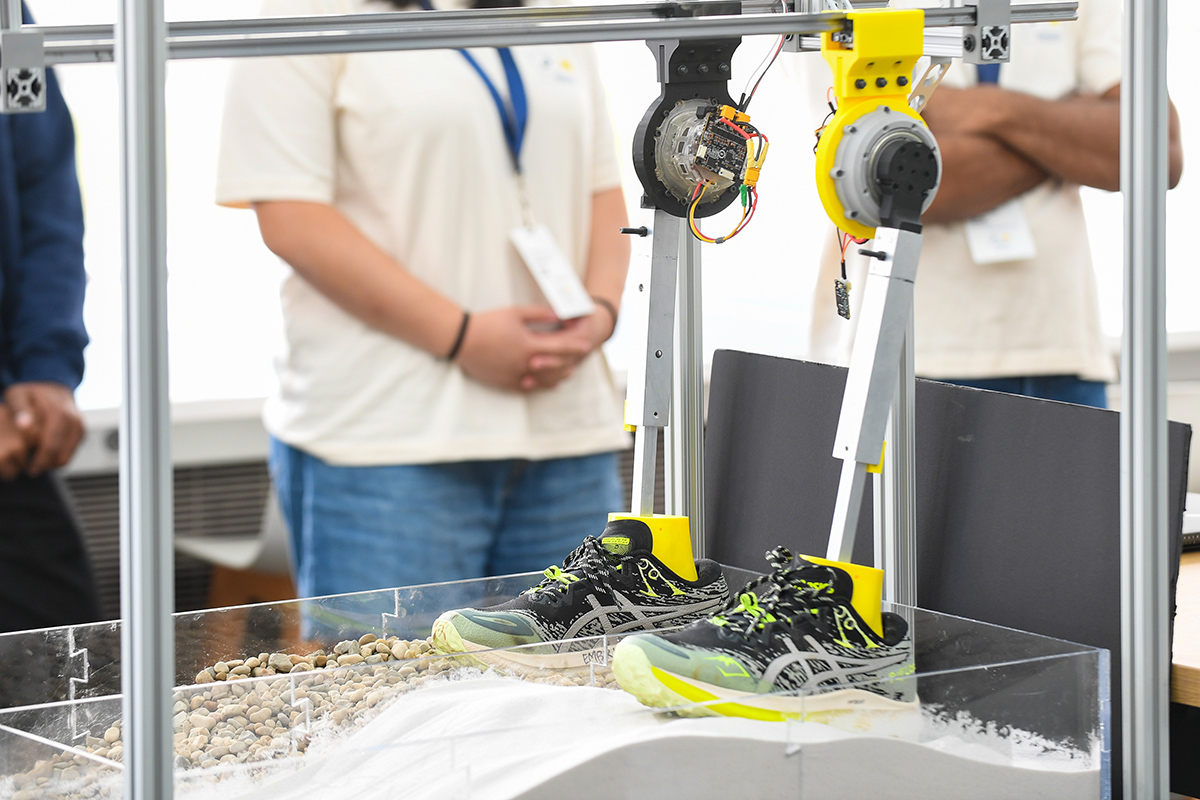
Ram Vasudevan will lead the biomechanics team that will use computer vision to predict runners’ movement and physical loading, while Talia Moore guides the study of how animals move on loose and uneven surfaces to dive into creating the most suitable footwear for unpredictable terrain.
Max Shtein heads the smart materials lab that uses structural principles inspired by traditional Japanese kirigami to build lighter shoes that are also adaptive, as Sean Ahlquist’s team will merge advanced knitting techniques, sensing and smart materials as a road map to truly personalize fit.
Elliott Rouse’s Neurobionics Lab will explore how wearable structures store and release energy to help reduce load on the run and trim fatigue while boosting propulsion on the run and Richard Gonzalez is set to study how preferences, perceptions and performance can filter into new opportunities for product design.