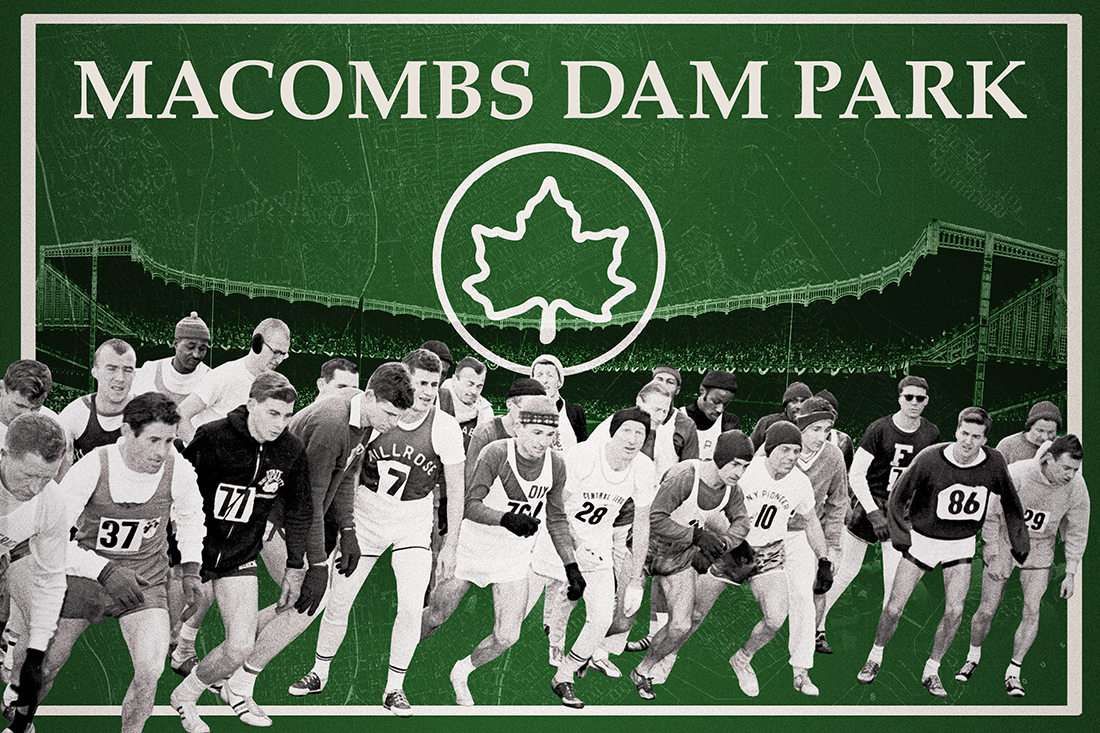
On Tuesday, October 8, 1974, the New York Times reported that a group of “Fifty joggers, ranging from Olympic team members to middle-aged Bronx residents who spend most of their time at sedentary pursuits” ran ten miles from Macombs Dam Park in the Bronx to City Hall in Manhattan to petition New York City Mayor Abraham Beame for funds to improve Macombs’ woeful conditions.
That those joggers – locals and outsiders, Olympians and couch potatoes – united to cover that distance on foot in an unsanctioned event was highly unusual at a time when sanctioned races of any distance only attracted a few hundred serious runners.
Nine days earlier, just 259 people finished the New York City Marathon.
The start and finish lines of this protest run embodied the transition of New York City’s organized road racing scene from its formative years in the Bronx, with Macombs Dam Park as the de facto nerve center, to its burgeoning rise outbound in Central Park.
Those joggers ran for the park that was hailed as the gateway to the Bronx, before the existence of Yankee Stadium across the street.
The park with a publicly accessible Parks Department building that became the first New York Road Runners headquarters and locker room.
The park with a cinder track that, despite becoming a moat after any rainfall, trained Olympians.
The park that established the Cherry Tree Marathon, which was the precursor to the vaunted New York City Marathon.
They ran for the park that was the cradle of the city’s organized running in the 1960s.

THE BEGINNINGS
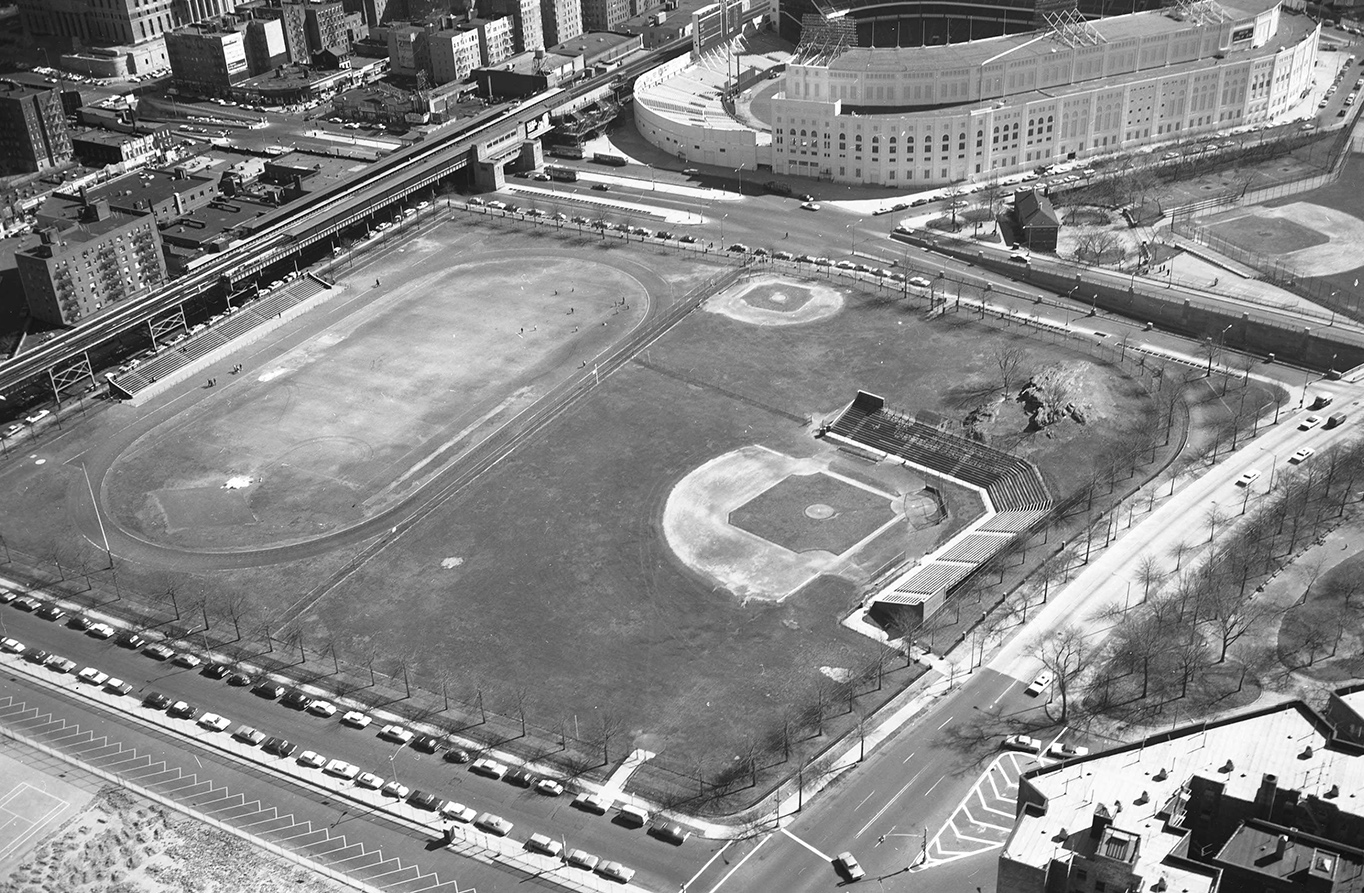
In the early 1800s, the current location of Yankee Stadium, bordered to the west by the Harlem River, was occupied by a grist mill owned and operated by the Macomb family.
Robert Macomb built a dam across the river in 1813 to facilitate boat traffic, and although the structure was removed in 1858, Macomb and his dam were memorialized by the name of the park that opened on his plot in 1899 after the city started acquiring the condemned land.
By the early 1900s, Macombs Dam Park featured playgrounds, baseball fields, tennis courts and a 440-yard track. The park was a recreational heartbeat – particularly for runners – in an otherwise developing area of the Bronx.
As early as 1907, the Times mentioned that the Atlas Athletic Club, established 1808, had its headquarters at 162nd Street and Jerome Avenue, next to the park. The article noted a monthly track meet that Atlas hosted at Macombs, praising the packed schedule of a “100-yard dash, 440-yard run, 1,000-yard run, novice; one-mile run, handicap; running broad jump, and running high jump.”
As a harbinger of Macombs’ decades-long legacy of inconsistent upkeep and persistent deterioration, in July 1914, the Times reported that park commissioner Thomas W. Whittle was lauded by the Amateur Athletic Union for “his efforts in placing Macombs Dam Park Athletic Field in proper condition.”
The article stated that Whittle “looked upon Macombs Dam Park as the gateway to the Bronx and that he expected to improve it in such a manner that it would rank with the finest of parks in New York City.”
Unfortunately, “proper” — most certainly not “finest” — was the loftiest descriptor that could be attributed to Macombs throughout the 1900s.
In 1923, the original Yankee Stadium, a far more recognizable gateway to the Bronx, opened just south of Macombs Dam Park.
The park, literally and metaphorically overshadowed by the hulking ballfield, remained a hub for runners even though it had started falling out of favor with the A.A.U. In May 1936, according to the Times, an A.A.U. meet at Macombs was “indefinitely postponed due to the poor condition of the old track and construction work yet to be done on the new,” and that “rather than risk injury to the athletes, the committee decided to set back the date.”
That year, Joseph Yancey, William Culbreath and Robert Douglas established the New York Pioneer Club, the nation’s first large-scale interracial track and field club. In the winter, the Pioneer Club trained and held meets at the 369th Regiment Armory in Harlem.
In the summer, the Pioneer Club could be found at Macombs Dam Park, despite the shoddy track conditions. And while his group was based in Harlem, in 1976 Yancey told the Times that “this club was founded because many of us were running around in Macombs Dam Park unattached.”
Pioneer Club athletes, including Olympic bronze medalist and 1968 Mexico Games protest icon John Carlos, logged countless miles at Macombs over the ensuing decades — and it was fitting that the park would be vital to the early stages of organized road racing in New York City when 22 NYPC members, including Yancey, joined the newly formed Road Runners Club, New York Association in June 1958.

THE ORGANIZATION
As per its first quarterly newsletter in the summer of 1959, the purpose of RRC-NYA was “to promote long distance running, specifically to try to increase the number of races in the territory governed by the Metropolitan A.A.U.”
At the time, the A.A.U. had a stranglehold on road racing throughout the country and would not sanction RRC-NYA as a race organizer — which it was — because they deemed it a competitive club, which it was not.
These types of hairsplitting A.A.U. policies made it nearly impossible for any club or organization to stage races at the local level. New York City had dozens of run clubs in the 1960s and the burgeoning RRC-NYA wanted to provide them with opportunities for competition and camaraderie outside of the A.A.U.
The A.A.U. ultimately relented, permitting RRC-NYA to host races as long as all A.A.U. members could participate. This allowed RRC-NYA to fulfill its mission of promoting distance running in the city with local races that the A.A.U. showed little interest in or had the staff to organize and proctor. In 1958-59, RRC-NYA sponsored ten races in the city in addition to those put on by the A.A.U.
Ted Corbitt, Joe Kleinerman and John Sterner led RRC-NYA during its formative years and were among the organization’s most influential early members as president, vice president, and secretary-treasurer, respectively.
According to Corbitt’s son, Gary, Sterner was the primary driver behind and most important person in launching RRC-NYA. Sterner, a Pioneer Club runner and racewalker, is not as well-remembered as Corbitt or Kleinerman, but was the lifeblood of RRC-NYA’s early governance.
In 2001, RRC-NYA co-founder and first president Ted Corbitt praised Kleinerman, vice president from 1959-60, and the Pioneer Club for being an early impetus for running in the Bronx.
“[Joe] began staging unofficial races in the Bronx before and after World War II, and later for RRC-NYA,” Corbitt said at the time. “Early on, these races were on the hilly Harlem River courses at Macombs Dam Park, and many of the practice races were highly competitive, thanks to the shortage of races in New York City. These races complimented the official races held at the time.”
By democratizing the A.A.U.’s authoritarian approach to road racing, RRC-NYA began to usher in the modern-day era of road running in the city and, subsequently, the country as a whole.
The first RRC-NYA races at Macombs Dam Park were a 15K in December 1958, an 11.2-miler in February 1959, the Cherry Tree Marathon in February 1959, a five-miler around Yankee Stadium in March 1959 and a 30-mile road race in March 1959 that was the first ultramarathon in the United States during the Road Runners Club of America era.
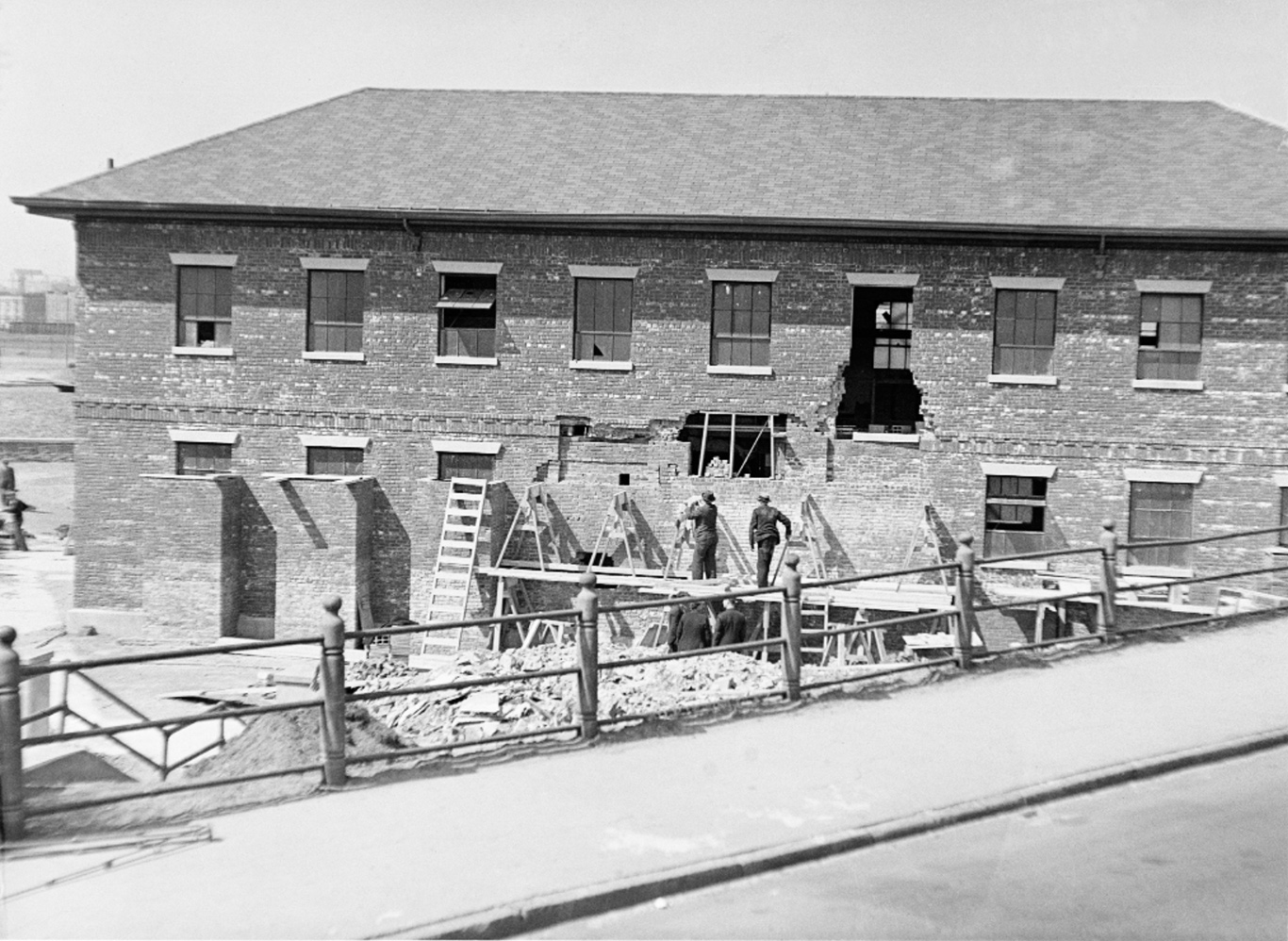
These races started and ended at Macombs in part due to the park’s legacy with the Pioneer Club and Kleinerman, and also for its publicly accessible parks department office with a locker room and showers. That building hosted early RRC-NYA organizational meetings and made Macombs the organization’s de facto race headquarters.
Then, in the spring – when locker room access became less of a necessity and Yankee fans started congesting the area – RRC-NYA would hold races in other parts of the city.

THE CLUBHOUSE
As a high schooler, Glenn McCarthy ran RRC-NYA races at Macombs from February 1965 until the spring of 1967 and remembered the parks department office being staffed by an employee who signed out basketballs and chess or checkers sets.
The worker was not as busy in the colder winter months, as the dedicated run crowd continued their workouts in the mostly empty park.
“During the time of the year that we used the area, there were few people beside the runners,” McCarthy remembered.
And the runners were only there for the locker room – or, as McCarthy referred to it, the clubhouse.
He described the clubhouse as having rows of lockers with short wooden benches fixed to the floor. A large bathroom had multiple urinals and several stalls with a separate room containing about a dozen showers.
McCarthy noted that only about 40 runners showed up for most Macombs races (with the exception of the Cherry Tree Marathon, which might have attracted 75), so the runners had plenty of room to spread out.
Dave Littlehales, a friend of McCarthy who also ran at Macombs, felt equally welcomed and intimidated when he first entered the clubhouse.
“When I got to the locker room, all of a sudden, I found myself at home. I found myself with kindred spirits,” he recalled.
As high school kids, McCarthy and Littlehales were wholeheartedly accepted and embraced by the other runners.
“Everybody there was so welcoming. There were only, like, 30 men, but they were all older,” McCarthy recalled. “Most of them were in their late-20s, but there were other guys, like Doc [Dr. George] Sheehan, who was in his late-40s, and it was just such a supportive, welcoming organization.”
Littlehales recollected that “I was this little kid from Long Island, 16 years old, being incorporated into this running community. I felt a sense of inclusion there.”
THE CAMARADERIE
Fellowship came from the top, not just the runners who congregated in the locker room.
Ted Corbitt, one of the earliest and most influential faces of RRC-NYA, was a renowned member of the Pioneer Club who was committed to promoting integration in athletic competition — not just for Olympians like himself.
Another Pioneer Club runner, Kurt Steiner, was an RRC-NYA mainstay whose dedication, kindness, and affability made him a clubhouse favorite. Kleinerman, a talented race organizer and seasoned runner who completed over 300 road races and 30 marathons, would loudly announce every runner who entered the Macombs locker room prior to a race.
In present day, New York Road Runners honors these early torchbearers with the annual Joe Kleinerman 10K in January and Ted Corbitt 15K in December. Prior to the COVID pandemic, it also held the Kurt Steiner 5K Cross Country race in Van Cortlandt Park.
Littlehales can distinctly recall the first time that Kleinerman broadcast his presence to everyone within earshot in the clubhouse.
“I remember walking in and Glenn came in right before me, and Joe Kleinerman, who monitored the races, said ‘Glenn McCarthy is here! Glenn McCarthy!’ And he would announce every runner that came through,” Littlehales remembered.
“And I thought, ‘Wow, look at that. He has the same importance as John Garlepp, or Doctor Sheehan, or whoever.’ And then he said to me, ‘What’s your name?’ and I said ‘Dave Littlehales.’ And he said, ‘Littlehales! Littlehales is here! Littlehales!’ and I’m going ‘Oh my god, he doesn’t even know me, and he’s announcing me.’ It was honestly an ego boost.”
Kleinerman and his number-two, Kenny Abramson, were the unsung Macombs race directors, coaches, and head cheerleaders. The pair, and everyone else who worked tirelessly to support RRC-NYA, did so voluntarily; paid not monetarily, but spiritually from the larger movement they were creating.
“I was amazed by these people, especially Kenny, who did this as volunteer work,” Littlehales raved. “They’d stand out in the cold, 20 degrees, for four hours for the Cherry Tree Marathon and I’d say ‘What kind of people are these?’ So devoted, and so supportive to us as runners at the time.”
“They were quite a team,” McCarthy said. “They were so supportive. We ran the same courses all the time and when you ran a best time on one of the courses, they’d acknowledge that. Uncanny that, with 30 or so people, they remembered your splits and your times. And if you made the mistake of starting too fast, often at the end of the race they’d tell you ‘Maybe next time you should be starting a little slower.’ They were a wealth of advice, especially for a youngster like me.”
THE COURSES
The Macombs running experience was all grit, no glamour.
Routes often wound through heavily-trafficked, sparsely populated (especially in the winter months) areas of the Bronx that were not at all runner-friendly. They just happened to be within a few miles of the locker room. As more and more runners started joining the RRC-NYA races, it was only a matter of time before the group outgrew both the locker room and the inherently perilous courses on which they ran.
The shorter courses included the five-mile Bob Preston Memorial that was 11 laps around Yankee Stadium’s perimeter sidewalk, and the 4 ¼-mile Henry E. Isola Memorial that was four laps around the Bronx Produce Market.
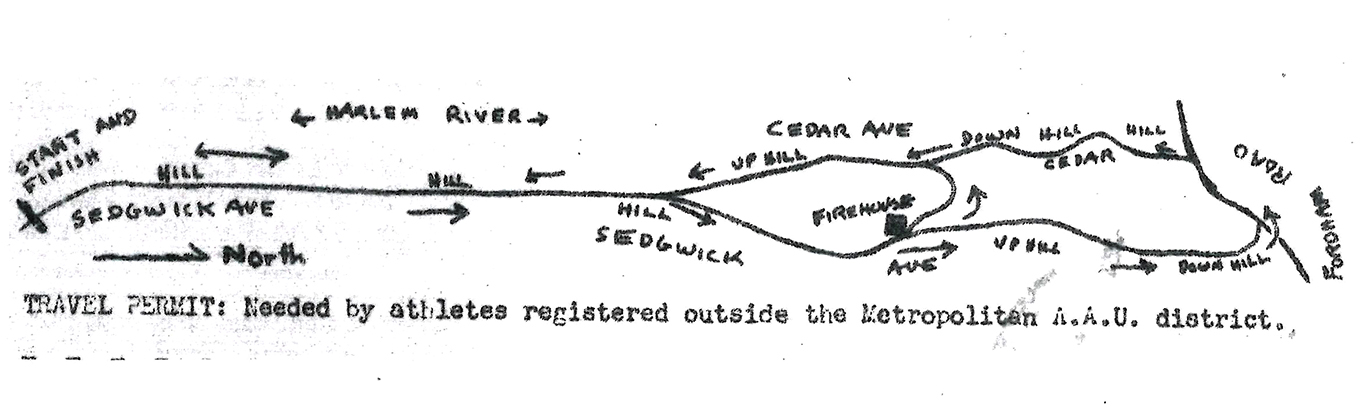
The annual Cherry Tree Marathon, the precursor to the New York City Marathon, was held at Macombs on Presidents’ Day Weekend from 1958 to 1970, and consisted of multiple loops of either “the short course” (4.02 miles) or “the long course” (5.34 miles) from Yankee Stadium up Sedgwick Avenue and looping back at Fordham Road.
The short course, which was already hilly, avoided additional elevation between the fire department Engine 43 and Ladder 59 firehouse and Fordham Road. In 1960, the Cherry Tree course was the first in the United States to be measured by an RRCA chapter.
In the weeks leading up to Cherry Tree, RRC-NYA hosted increasingly long races, up to 20 miles, on Sedgwick Avenue or along the Major Deegan Expressway.
“The routes that ran along the Major Deegan Expressway – they were kind of scary,” Littlehales said. “We had cars zipping up and down, and really no police support at all, except maybe an intersection or two.”
He similarly described the runs along Sedgwick Avenue, which started about 500 yards from the locker room at the corner of Sedgwick and West 161st Street as, quite simply, “dangerous.”
THE INCLUSION
As RRC-NYA continued its mission to promote distance running throughout the 1960s, the organization continued to grow and expand beyond the friendly, if rudimentary, clutches of the Macombs clubhouse.
By the spring of 1971, RRC-NYA, which in 1958 had 47 original members – had ballooned to 279 members.
The organization’s races were so well-attended that the full results lists became too long to be published in the RRC-NYA quarterly newsletters. McCarthy noted that, during the 1960s, “lots of runners found Macombs and it became a way for them to improve.”
The runners who found Macombs varied in age, from preteens to masters.
Barry Geisler, RRC-NYA president from 1971-1972 and cofounder (along with Kurt Steiner) of its age group program, had two elementary-age sons who started running in the Bronx in 1966.
One of them, Barry Jr., went on to run a 3:17 marathon at age 12. NYRR’s youth development program exists today in the form of Rising New York Road Runners, “a free running-based youth program designed to make physical activity enjoyable and accessible for kids nationwide” that is open to kids from pre-K thru grade 12.
For older runners, RRC-NYA hosted the first-ever masters division race in the United States, a four-miler at Macombs, on July 2, 1961. Since then, masters divisions have become ubiquitous at large track meets and road races and that spirit of competition has encouraged countless runners to continue pushing their limits into their 40s and beyond.
Fittingly, this year’s Abbott World Marathon Majors Age Group World Championship will be contested at the New York City Marathon.
Female runners started finding their way to Macombs in 1971 and their pursuits were wholeheartedly welcomed and encouraged by the RRC-NYA runners and administrators alike.
Nina Kuscsik ran the RRC-NYA 20-milers in advance of being the first female finisher at the 1971 and 1972 Cherry Tree Marathons, and in March 1971, Anita Scandurra, teenage daughter of RRC-NYA president (1964-1966) Aldo Scandurra, finished 31st of 44 runners overall in a four-miler in 26:22.
Anyone with ambitions of miles was welcome to run with RRC-NYA at Macombs Dam Park until the group finally outgrew its humble roots and moved to Manhattan — specifically, Central Park.
THE DEPARTURE
The proverbial cherry on top of RRC-NYA’s decampment from Macombs was that the Cherry Tree Marathon, RRC-NYA’s signature race, was last contested at Macombs in 1970 before moving to Central Park in 1971.
The Central Park version of Cherry Tree was contested in March, six months after the New York City Marathon was inaugurated in Central Park in September 1970. Two years later, the Cherry Tree Marathon moved to Roosevelt Raceway on Long Island and became known as the Earth Day Marathon.
The relocation and subsequent relegation of the Cherry Tree event allowed RRC-NYA to focus its marathon-related efforts on administering the New York City Marathon, which became Central Park’s preeminent marathon from 1970-1975 before first traversing all five boroughs in 1976 and boldly revolutionizing the concept of urban marathoning on a global scale.
Today, the New York City Marathon is one of the world’s preeminent marathons, with over 55,000 finishers, two million spectators, and 10,000 volunteers.
THE DEMISE
The last RRC-NYA race at Macombs Dam Park was a 20-miler on March 5, 1972 that served as the final training run for the final Cherry Tree Marathon on March 19.
RRC-NYA enhanced its status and influence in Manhattan and eventually became known as New York Road Runners, while Macombs Dam Park resumed its status as a fair-weather track and field venue for the Pioneer Club, local residents and school-age kids. The aforementioned ten-mile run from Macombs to City Hall in October 1974 did not inspire financial assistance, nor did pushes from various community members and elected officials over the span of several decades.
On July 15, 1976, Macombs Dam Park held the first annual Joe Yancey Relays.
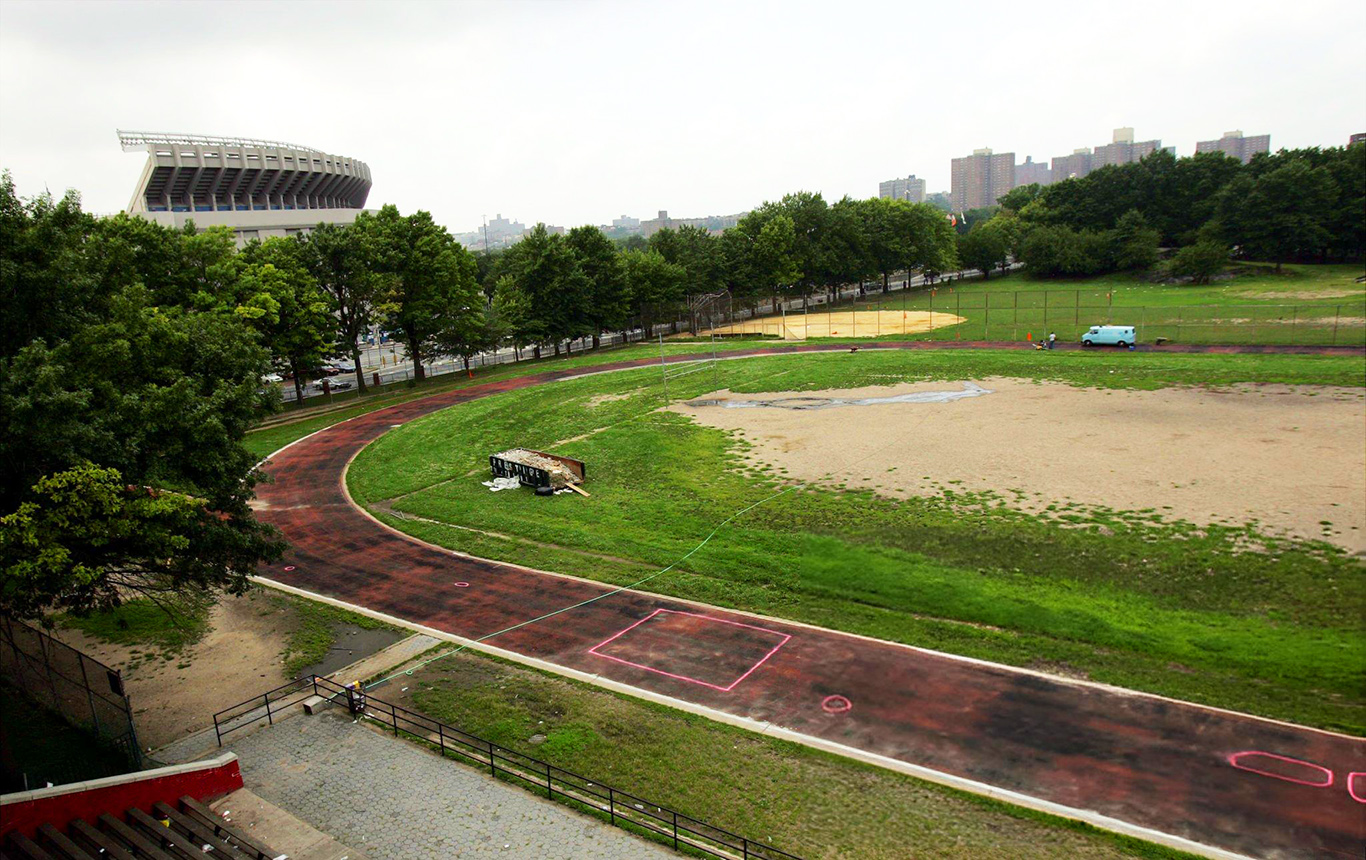
The sad state of the Macombs track sat in stark contrast to that year’s multimillion-dollar refurbishment of Yankee Stadium, as demonstrated in the Times review of the meet preparation: “Rain had made a lake of the infield and a moat of the quarter-mile track by 9 a.m., the scheduled starting time of the meet. But by 1:30 p.m. the 10-to-15-man crew had cleared the puddles and put down fresh running lanes and the meet was ready to begin.”
Yancey, who knew the quirks of the Macombs track better than anyone, told the Times that when “I woke up this morning, I saw the rain and I never thought they’d be able to hold a meet today.”
Yet runners still showed up to honor Yancey by circling the shoddy track within the drab park that no city administrator seemed to care much about – particularly with New York City itself infamously on the brink of bankruptcy.
With NYRR firmly encamped in Manhattan, the Macombs locker room was no longer a clubhouse and the ramshackle track served as the only running-related vestige in the humble park that served as the birthplace of organized running in New York City.
The Macombs track continued hosting school meets and local runners for the next three decades, and in 2006 its lack of upkeep finally paid off when the entire park was razed to clear the way for the $800 million new Yankee Stadium that would be built in its footprint and open in 2009.

THE REBIRTH
A land-swap deal with the Yankees guaranteed that Macombs Dam Park would be reestablished across the street after the old ballpark was demolished.
Part of the new park featured a brand-new track, named for Yancey, which was built on a small plot that was, for a brief period, in the shadows of both the new stadium when it first opened and the old stadium before it was demolished. The clubhouse, of course, was long gone and with it all evidence that one of the world’s most renowned running organizations and prestigious footraces can trace their roots to a small Parks Department building nestled in the corner of an inconspicuous urban park.
In April 2010, according to the Times, “a few hundred people had gathered in the shadow of Yankee parks old and new to celebrate Joseph Yancey, a legend who coached track and field because he loved it. His name – on a regulation issue Parks Department sign – traces the track at the new Macombs Dam Park, which itself was legendary for generations of Bronx runners.”
The Parks Department officially proclaimed that the Joseph Yancey Track and Field at Macombs Dam Park is “a state-of-the-art 400-meter track with surfacing that has been used at the Summer Olympics.”
After nearly 100 years, the Macombs track could finally be deemed among the city’s finest — and busiest.
Yancey’s namesake track, located where the house that Ruth built once stood, is the only remaining connection to the old Macombs park as the birthplace of NYRR, the organization that RRC-NYA built.
That old Macombs Dam Park, the unsung gateway to the Bronx that blossomed into the gateway of New York Road Runners’ once emerging – and now thriving – legacy of opportunity and community for runners locally and beyond.