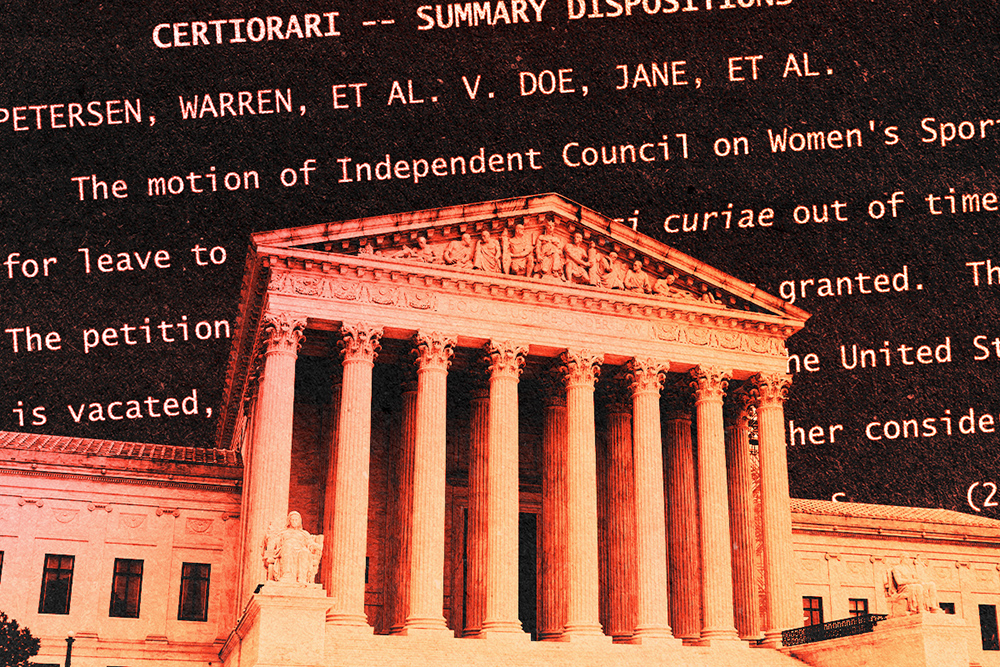
The Supreme Court on Tuesday ruled in favor of state laws involving Idaho and West Virginia that ban transgender athletes from girls’ and women’s sports.
A six-justice conservative majority indicated that the laws in both states do not violate the Constitution which will impact 25 other states that have the same kinds of regulations.
In his syllabus briefing on behalf of the court, Justice Brett Kavanaugh noted that the “question before the Court in these cases is whether, under Title IX and the Equal Protection Clause of the Fourteenth Amendment, schools may maintain women’s and girls’ sports teams for biological females, i.e., may schools determine eligibility for female sports based on biological sex? In the past six years, 27 States have enacted laws that maintain female sports for biological females.”
The nearly 30 states that have restrictions in place could likely use the ruling to further reinforce and extend the reach of their policies.
President Donald Trump, whose administration has supported the state bans, praised the decision in a social media post on Tuesday, labeling it as a “BIG WIN.”
At the focal point of the 6-3 vote among the justices were the challenges of state laws from transgender students, Becky Pepper-Jackson, from West Virginia and Lindsay Hecox, from Idaho.
Pepper-Jackson, 15, sought to join the middle school’s girls cross-country team when she was 11 and accused her school of violating Title IX regulations that prohibit sex-based discrimination. Hecox is a 25-year-old college student and tried to join her school’s women’s track and field and cross-country teams at Boise State University but denied because of House Bill 500 in Idaho which banned trans women and girls from sports in the female category.
Both Pepper-Jackson and Hecox have taken estrogen treatments and had their cases initially heard by the Supreme Court in January after more than two years of navigating the legal process.
And while less than two percent of the Americans who identify as transgender participate in sports competitions, the matter of transgender athletes has been a priority for the Trump administration. Trump has pushed to remove federal funding from any institution that has allowed transgender athletes to compete in girls’ and women’s sports.
“In so ruling, we emphasize one last point,” Kavanaugh wrote in the briefing. “Most of the biological female and transgender student-athletes who are involved in transgender sports disputes around the country are teenagers or in their early twenties. Those student-athletes want to play sports. Their desire to compete warrants respect. No student-athlete on either side of the issue, whether a biological female or transgender, deserves to be ostracized or vilified.”