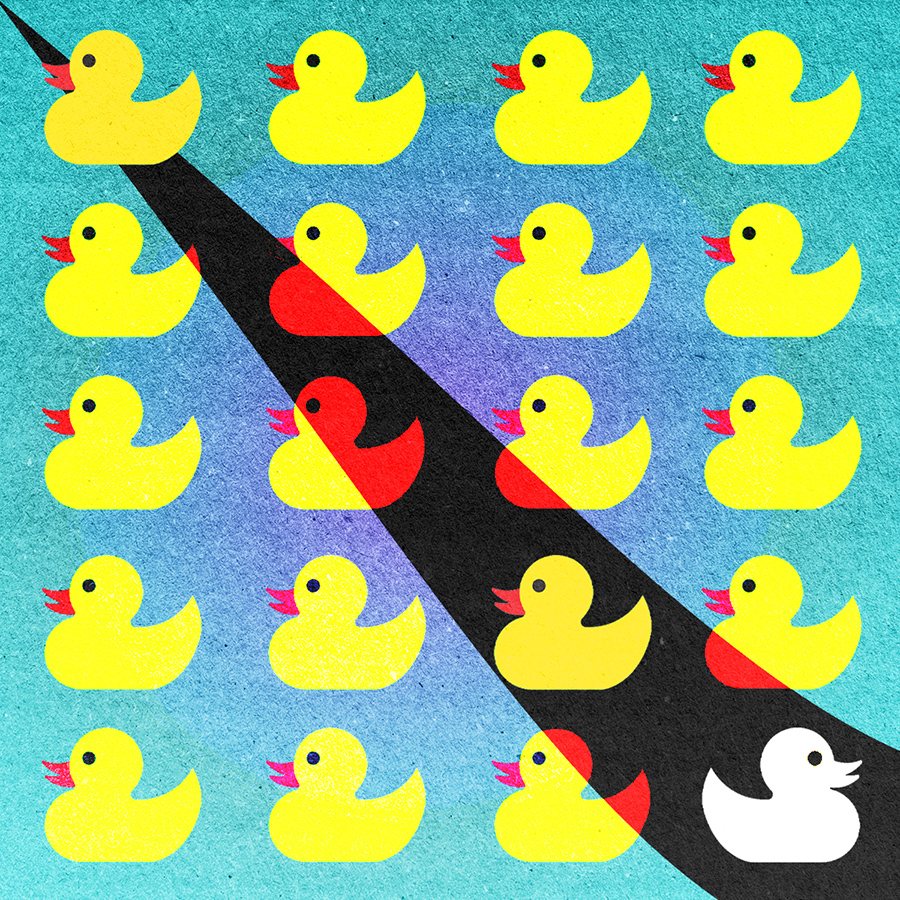
A few years ago, I almost became a duck. I was nearly forty, and yet I related to how students at pressure-cooker universities sometimes describe themselves: gliding along on the surface while my legs churned furiously below.
It wasn’t that I was failing, at least not if you asked the internet. I had a good job at The New York Times, and raced marathons on the weekends, for fun. Every spring break, students would send messages asking how to be like me, and I’d usually shoot back the same advice I told myself: Keep showing up. Never, ever quit.
But it was starting to feel a little like a lobotomy. The harder I worked, the duller I grew. Instead of moving forward, I was spinning and stuck. In other words: like an aimless, exhausted little duck.
Obviously, I pushed even more.
I described this instinct to grind through my problems and white-knuckle toward my goals with one powerful word: “perseverance.” For years, I applied that word indiscriminately to almost any challenge in my life.
Want to get a raise? Perseverance.
Want to bounce back from an injury? Perseverance.
Put salt instead of sugar in your coffee? Perseverance. Stir it up, drink your salty beverage, and do better next time.
No matter the obstacle, my strategy was always the same: lock in, fight harder, and wait for the universe to reward all this dazzling, courageous work with the breakthrough I surely deserved. And if it didn’t—well, I hadn’t persevered hard enough yet.
One thing that definitely did not occur to me: sometimes, perseverance is not a good idea.
As it turned out, I was not the only one who missed this revelation.
A consultant I knew was on the road more than he was home — his life mapped out in conference rooms, his kids growing up without him. He’d been passed over for a promotion and didn’t care about the work. But what would he do instead? There he was on a plane every Monday, blocking out the sunrise with a shade.
A psychologist I’d run with was drowning under her client load and taking meds to cope. But her client list kept expanding, along with her income — and after all, didn’t she want to help people?
A woman I met was ready to break up with her boyfriend of four years, but she was thirty-six, and she wanted kids. Yes, the relationship was withering, but what if she broke it off — and wound up with nothing?
Almost everywhere I looked, there were ducks. Appearing calm on the surface as we churned below, and desperately wanted — needed — to stop. If you talked to most people long enough, it became clear that in many cases, there was one obvious solution: quitting. But we couldn’t do it.
Something was holding us back.
Our bills.
Our families.
Maybe our self-doubt?
Certainly our self-respect. No one wants to admit failure — or worse, that they succeeded, but they’re still unhappy.
The obstacles to stopping were real. There were financial reasons (If I quit my job, how will I pay my rent?). Some reasons were social (If I break my engagement, what will my friends think?).
Some were psychological (What if it works out in the end?). Some were existential (If I quit, what else is there?). Some involved a reluctance to cut losses (I spent too much time and money conquering undergrad / grad school / residency / fellowship to quit my career now). Some were tied to identity (If I’m not a college athlete, who am I?). Sometimes it was fear of judgment, change, regret. Sometimes it was even laziness: hard as it may be to stay, it can feel easier than the disruption of stopping. Sometimes it was determination. Defiance. Grit. Pride.
At first, I wondered if some of these stories amounted to luxury problems. Was it all just a Misery Olympics, an arms race trying to weave adversity into lives that were actually pretty great? These weren’t problems with what we lacked, after all. These were problems with what we had.
Maybe for some, problems like these overrode the stories we like to tell ourselves (“I want to quit, but I’m simply too important”). Maybe what some of us really needed wasn’t a life overhaul.
It was a reality check.
But the more strangers I spoke to, from a range of backgrounds, the more I kept hearing the same themes. People were pushing themselves past their limits. They were staying on paths they’d outgrown. Sometimes, they were even staying in situations they knew were bad for them.
And they didn’t know why. They certainly didn’t know what to do instead.
They weren’t alone. At any given time, roughly half of us are secretly considering leaving our jobs. Young professionals under thirty-five are the most restless, but they stay. They’re bound to join the three in five workers who later in life confess to a deep career regret: lingering too long in roles that are no longer right for them.
Our personal lives can be just as sclerotic. More than half of Americans believe we stay in unhappy marriages too long. Sixty-four percent of us criticize social media — but roughly three-quarters of us still maintain accounts on the platforms we despise.
Even at the threshold of major life transitions, we hesitate. About a third of us who can afford to step back at retirement age instead choose to keep working. When it comes to mobility, Americans (especially millennials and younger) are increasingly staying put — moving at the lowest rates in recorded history. As a New York Times headline once declared, “The typical American lives only 18 miles from Mom.”
Just like me in my little duck pond, drinking my salty coffee and reveling in my ability to put up with it all, we call this wallowing “perseverance” and will ourselves to just keep at it while we deny the mounting costs. But there’s a fine line between persevering and enduring. Instead of fighting for some powerful reward, my fellow endurance masters and I were gritting our way through our lives. Why couldn’t we see that? Why was everyone so stuck?
Lindsay Crouse is the author of “The Case for Quitting,” from which this essay is adapted. She was formerly a senior staff editor in Opinion at The New York Times. Copyright 2026 by Lindsay Crouse. Reprinted by permission of HarperOne, an imprint of HarperCollins Publishers. The book can be purchased via HarperCollins Publishers.