“Reset phase” was the term used in Puma’s third quarter earnings report in late October, accompanied by news of 900 corporate jobs on the chopping block in part of a move to revive the company by 2027.
It was a familiar sentiment that summed up a period where the company revised its own financial outlook and said in July that it would take a loss for the year. Months earlier in April, a new CEO would be the helm as Arthur Hoeld took over for Arne Freundt in a move described by Puma as “differing views on strategy execution.”
And just a month prior, to Hoeld’s arrival, the company revealed 500 corporate positions would be eliminated.
The bigger picture was Puma’s shares were down more than half in 2025 — trading near its lowest since 2016 — and amidst the internal announcements of restructuring, the nearly 80-year-old brand was suddenly the talk of being sold.
A major dip in valuation would make it nearly impossible for Artémis, a holding company for Puma’s largest shareholder, to agree to an acquisition (and possible talks).
Still, word of a Puma sale became more than just industry as the apparel and footwear would try to stay afloat and away from it’s revenue struggles by launching measures inside and out.
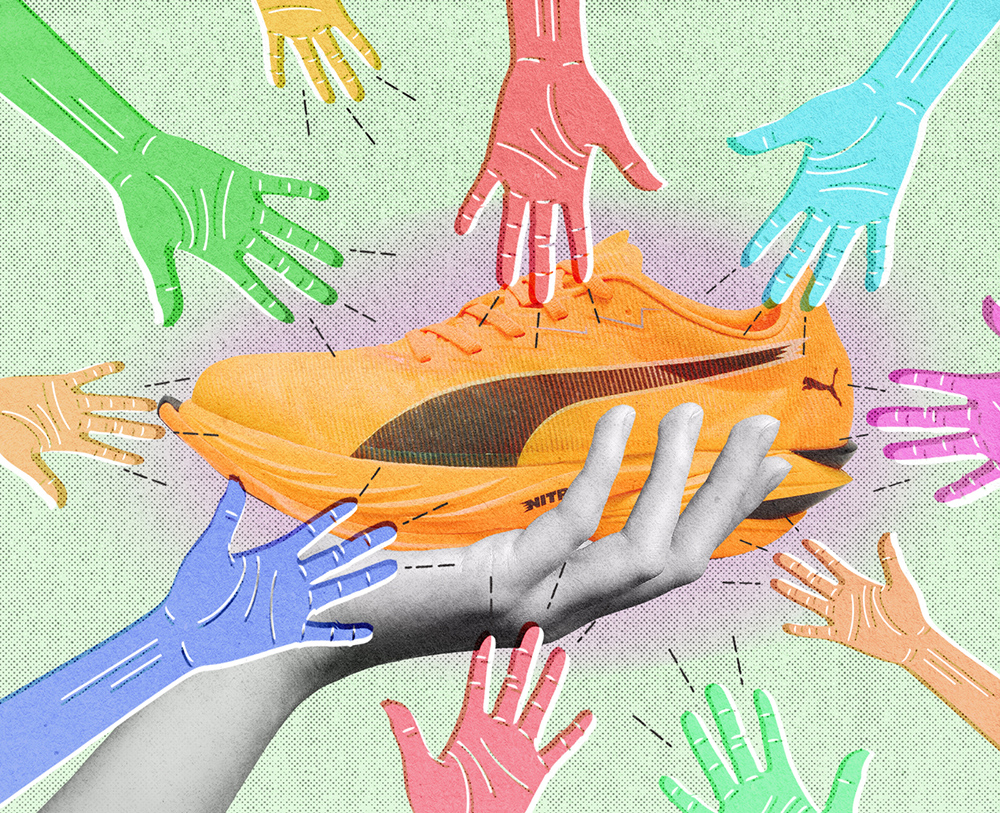
Highlights seemed few for the company and one of the brightest this year came with the performance of the widely hailed Fast-R Nitro Elite 3, a shoe which continues to draw praise from distance runners motivated to push for more speed. The model has also tipped the narrative away from rival brands now set to tally their year-end shoe podiums on the world stage.
But a single shoe is hardly a savior when apparel and accessory lines are the intended volume sellers far away from specialty retailers. And Puma has been upfront in its own earnings reports about trying to cut down on discounting from sellers and boost its effort to reach customers through direct channels — and at full price.
For now a turnaround might not be within reaching by the 2027 timeline as a growing speculative list of buyers for Puma resembles a range of credible to simply unproven. Still, any interested companies with deep pockets have a single trait in common: Puma would continue survive as a part of their roster.

Anta
Anta has been mentioned in numerous reports as the leading suitor to make a serious offer for Puma and has already demonstrated that it can take on — and maintain — a non-Chinese brand. With a $30 billion valuation, Anta is said to have already brought advisors on board to facilitate an offer for if the company decides to move forward. Meanwhile, Anta’s accessibility to cash and the potential to partner with a private equity firm make a prosed deal more reality than rumor.
Anta’s is mostly known in the United States for its collaborations with basketball stars Kyrie Irving and Klay Thompson on signature sneakers, but has quickly risen in the running landscape. In early December, the company had a notable presence in its debut at The Running Event in San Antonio, Texas, a key event for specialty retailers but also was a signal to better known rivals that it was here to stay. Four new or updated performance running shoe models were unveiled but bringing Puma on board would give Anta instant positioning as a global running player, lifestyle brand and holder of a heritage label.
The company already owns Arc’teryx, Salomon, Wilson and others under as a majority shareholder as part of a deal for Amer Sports — outright owns several brands — but Puma could be its biggest prize.
Li Ning
Another Chinese giant monitoring a chance to make a potential offer at Puma is Li Ning. In late November, it was mentioned among several companies with deep pockets that were eyeing Puma, which sent shares of the German brand soaring 19 percent in Frankfurt Stock Exchange. At $5.9 billion valuation, Li Ning is poised to bolster its position globally and beef up its portfolio with an established brand like Puma while competing on an international stage beyond China.
Adding Puma to its core would come with instant footing in North America and Europe as it utilizes existing distribution channels and a legacy nameplate worth rebuilding. Li Ning has said it is not pursuing interest in Puma despite growing talk involving the brands.
Adidas
A longtime rivalry between Puma and Adidas has origins from the 1940s when a feud between brothers Adolf and Rudolf Dassler ended their business relationship and led to the creation of both brands. Adolf would lead Adidas while Rudolf created Puma and the brands continued to etch their respective places in the business mix of sports, footwear and lifestyle long after the brothers died in the 1970s.
With Puma on the ropes, a union between both companies could create a German powerhouse anchored by robust running, soccer and lifestyle categories. In mid-September rumors surfaced that if Puma would ever be sold, Adidas would the best — and likely fit — as shares climbed 5 percent on the speculation.
Authentic Brands Group and CVC
In September Authentic Brands CEO Jamie Salter and Alex Dibelius, a managing partner at private equity firm CVC’s reportedly sought to buy the Pinault family’s 29 percent stake of Puma as part of a larger takeover. Shares of Puma immediately jumped particularly because Authentic Brands is regularly briefed on potential acquisitions and has a footwear roster that includes Reebok, Airwalk, Tretorn, Frye, Hunter, Sperry, Rockport and Bandolino. Authentic Brands purchased Tretorn from Puma in 2015 in deal where terms where not disclosed.
Asics
In what could be seen as a bit of a dark horse, Asics has been mentioned as having interest. The Japanese brand has thrived with the recent resurgence of retro running footwear standouts like the GEL-Kayano 14 and GEL-Lyte III 07 tapping directly into lifestyle consumers who are pushing fashion over function. Collaborations with Kith, Ronnie Fieg, Concepts, Kiko Kostadinov, Atmos, Bodega, Hidden.ny and Comme des Garçons Shirt have kept the style pipeline ahead of other footwear rivals. Meanwhile, Asics gave its performance running stable a boost this year by adding the Megablast and Sonicblast to a growing “Blast” family with the Asics Novablast 5 emerging as a daily training overachiever.
Asics, like Li Ning, has denied that it was exploring talks or even pointing itself in Puma’s direction for consideration of a possible bid.
Puma stays put
A realistic option is Puma will stay the course and put stake in a turnaround that is already in liftoff. With shares worth less than half of it value, it can easily be figure that the Pinault family’s Artémis holding company would resist selling as Puma’s marketshare lags. Any discussion about a possible deal for the company must meet the family’s approval and Hoeld’s rebound plan could extend Puma’s lifeline under its own power — for now.
Meanwhile, the Pinault family — as its largest stakeholder — has previously been rumored to have explored a sale of the company earlier in the year. Any discussion or proposed deal would have to meet the approval of its Artémis holding company. Another roadblock is Puma’s market value has lagged and the family would likely resist making a deal and would rather see the how the company would possibly rebound under Hoeld’s leadership.