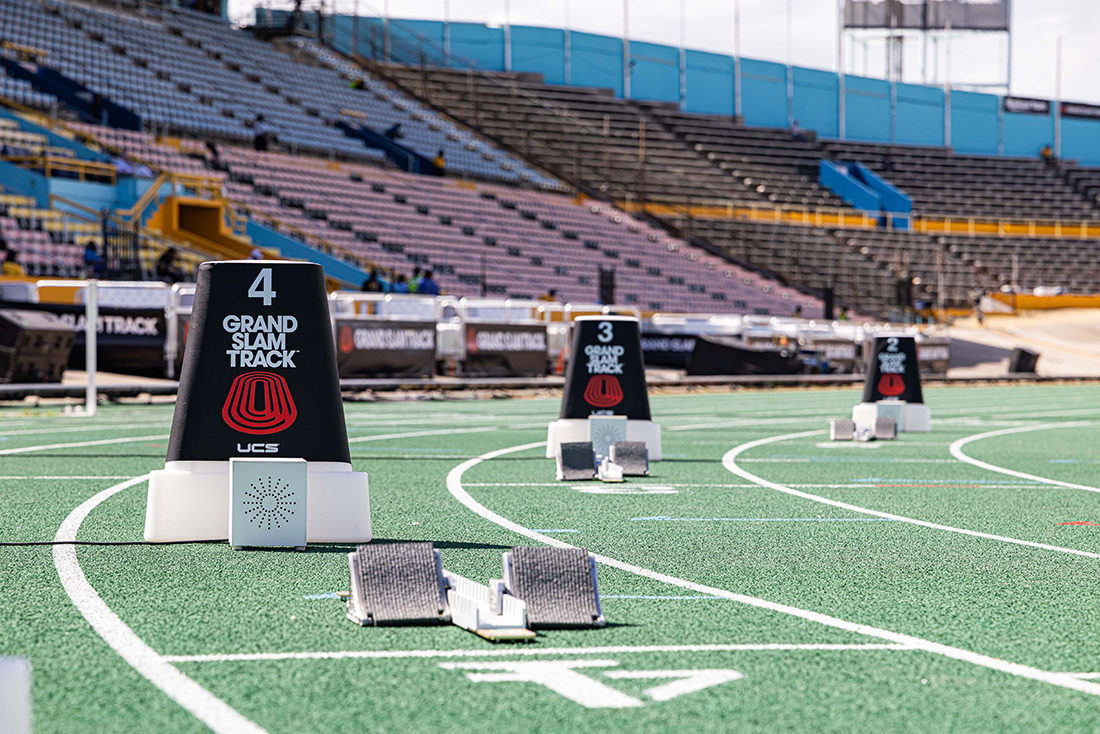
Grand Slam Track’s ongoing bankruptcy proceeding will continue through the new year as a recent disclosure revealed the extent of the league’s debts now stand at $31.4 million.
In an interim order issued last week in the U.S. Bankruptcy Court for Delaware, the league’s largest initial backer, Winners Alliance agreed to supply it with a new $3.25 million loan. The funds, however, will not be used to pay its creditors but instead will be directed toward restructuring and operating expenses.
The additional lifeline from Winners Alliance is a sign that it believes in the viability of the league after providing $13 million in funding in 2024. But in the filing, of the $3.25 million in new cash, $1.58 million will be allocated to operating expenses and $1.45 million will go to restructuring costs so Grand Slam Track can continue the bankruptcy in the new year. Just $200,000 of the remaining funds will set aside for “Racer Contract Guarantees,” which is presumably appearance fees for some of the athletes who agreed to appear at all four scheduled meets this year.
A portion of the new loan’s operating will cover $421,643 in salaries for the league’s remaining staff.
Meanwhile, the league says that as of the time of the filing last week it has $143,126 in cash on hand.
A formal announcement that Grand Slam Track was filing for bankruptcy drew a wave of headlines in early December but was not unexpected after months of speculation over major financial issues since the league’s final scheduled showcase in Los Angeles was canceled in June.
The initial bankruptcy filing showed that the league had more than 200 creditors which included top talents like Sydney McLaughlin-Levrone, Gabby Thomas, Kenny Bednarek and others who had not received appearance fees and prize money dating back to the inaugural meet in April in Kingston, Jamaica. But the poor spectator turnout at the event turned out to be a critical turning point for the league behind the scenes.
According to the updated bankruptcy filing, in March Eldridge Industries “decided to wait on committing” to the league until after seeing how the first meet in Kingston fared before potentially investing. After poor ticket sales and attendance at the meet were apparent — especially during the television broadcast — Eldridge declined to financially back the league. A non-binding term sheet Grand Slam Track entered with Eldridge was off the table and the league’s cash flow issues began.
The subsequent two meets in the Miami area and Philadelphia in May showed significant progress in ticket and merchandise sales. But the Philadelphia meet was trimmed to two days instead of three, which led to rumors that the league made the change as a cost-saving measure. But organizers said the format adjustment was in response to audience feedback.
January will mark a significant milestone in the reorganization timeline for Grand Slam Track.
League founder Michael Johnson is still operating the league, according to the latest filing with Stephen Gera serving as chief operating officer. But they must submit a comprehensive disclosure statement “which shall provide that GST emerges reorganized” by January 30.
And by April 15, the new loan from Winners Alliance will need to be repaid in full or converted into equity.
Still, the league will have to settle its debts before another season is proposed, while gaining the trust of the sport’s top talents will be a major hurdle.
World Athletics, one of the league’s creditors, rejected a plan from Grand Slam Track in November to accept half of what it was owed. Sebastian Coe, the governing body’s chief, told the media in his year-end address on December 17 that his organization has to “police the calendar.” Coe stopped short of directly mentioning Grand Slam Track directly but alluded to there needing to be oversight for events and leagues that represent the sport — and its reputation.
“We welcome innovation into the sport,” Coe said. “We welcome fresh investment, but it has to be underpinned by a sustainable, solid financial model executed and delivered on behalf of the athletes.”