Just a day from the inaugural Ultimate Championship in Budapest, the final touches on the competition are completed as viewers and spectators inside Gyula Zsivotzky National Athletics Centre are set to see a revamped take on a traditional meet.
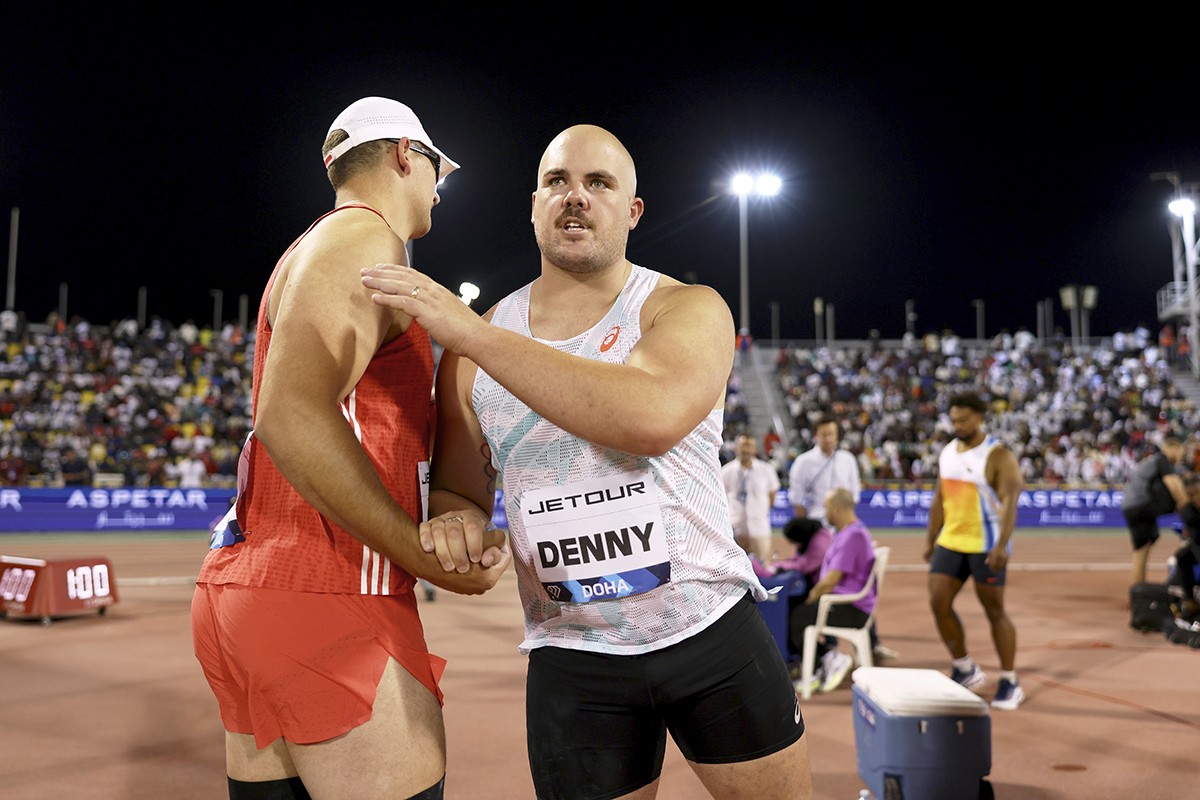
But Olympic discus bronze medalist Matthew Denny won’t be part of the over two dozen events in the three-day program and called out the decision not to include his signature discipline — and others.
In an open letter posted on Thursday on his social media account, Denny thoroughly questioned why a host of athletes like him won’t get their shot at a portion of the $10 million prize pot set aside by World Athletics and a chance to end the season with a roar.
“For many athletes, that kind of opportunity can change a career and a life,” Denny said in his message. “I support the concept of the Ultimate Championships. Athletics needs innovation. We need to improve the broadcast product, attract new audiences and find better ways to grow the sport. But innovation should not come at the expense of opportunity.”
Denny is still riding the wave of a 67.73m gold medal throw for Australia at last month’s Commonwealth Games in Glasgow and took issue with a host of field events being excluded, like the discus but also the shot put, decathlon, heptathlon, steeplechase and even the race walk.
There are no men’s or women’s 4×100m or 4×400m relays or men’s triple jump and women’s hammer throw, leaving Denny to wonder how current and future track and field audiences can be fully immersed in a sport that has chosen to scale back a major competition from the start.
“One of the main arguments for reducing or excluding certain events is audience interest,” Denny said. “We hear about clicks, viewing numbers and the need to create a better broadcast product. But I think there is a problem with that argument. When events are minimally shown on broadcasts for the last 20 years. You lose the reasoning to say people don’t want to watch.”
And while it might always have been the intent to focus on a tidy number of events, for some, the “ultimate” moniker should denote a meeting that casts more of a wider net for the sport’s 2026 finale.
When the competition kicks off on Friday, three field events will be part of the program, with the women’s high jump final, men’s hammer throw and men’s pole vault final featuring event headliner Mondo Duplantis.
There is plenty of precedent with competitions not including a full slate of events. During the Diamond League series, the schedule is crafted to evenly distribute and rotate disciplines across the season.
The league offers 32 point-qualifying events (16 for men and 16 for women) and each discipline is staged around 4 to 8 times across the 14 qualifying meetings with an expanded final showcasing a larger slate in a two-day program. These variations allow for meetings that are noticeably different in each city and helps pack the competition in a tight television broadcast window.
Last year, Grand Slam Track drew notable attention for leaving out field events altogether, a move that saw marquee field athletes like Tara Davis-Woodhall openly criticize the league on social media.
But Denny adamantly pointed out that even the top global governing body in the sport should not have final say in which athletes get what opportunities while limiting exposure for others.
“You cannot control what gets shown, what gets promoted, whose stories are told and which events receive the greatest exposure, then simply point to the result numbers as proof that people do not care about everything else,” Denny said. “If an event is struggling for attention, before deciding the event is the problem, we should be asking whether we have genuinely given it the opportunity to succeed. Because these decisions have real consequences. Access to major competitions affects prize money, world rankings, qualification, sponsorship, exposure and ultimately an athlete’s ability to make a living from the sport.”
When World Athletics announced the Ultimate Championship in 2024, the mission was to keep the stakes high and the quality of competition soaring during non-Olympic years and no world championships.
In the weeks leading up to what will be a calculated spectacle in Budapest, the focus shifted to on-track innovations, bold visuals and making and making sure the program flows like a storyline on the broadcast. The schedule, unveiled last November, reflected a push for a fast-paced timeline that translated well in the stadium and on screens globally.
“It is three evenings of three hours each: a straightforward final for the field events and a semi-final and a final for the track events,” World Athletics president Sebaastian Coe said when the schedule was announced. “It is important that our fans get the opportunity to see the best of the best.”
Denny, seemingly on behalf of the athletes, wants “transparency around how these decisions are made” in an effort to ensure all disciples are treated fairly, while maintaining compelling matchups.
Still, he seemed willing, and hopeful, to find some kind of common ground with leagues and organizations to build solutions that include all of the sport.
“What we have to offer isn’t [a] problem,” Denny said. “How we present it might be. The challenge should not be deciding which parts of athletics we can afford to leave behind. The challenge should be figuring out how we make people care about all of it.”