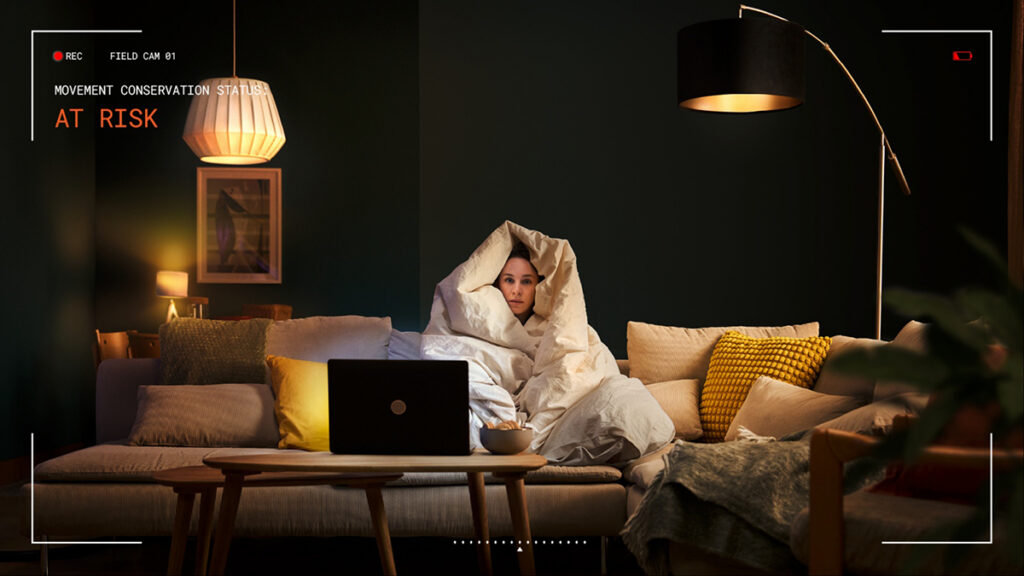
Asics is shining a beacon of movement toward prying people away from sedentary habits with “Human Nature,” a mockumentary of sorts narrated by actress Sigourney Weaver that casts humans as endangered species.
The 10-minute film looks at three people, Hannah who is willingly couch-bound while binge-watching shows, with Janet seemingly trapped behind the walls of an office cubicle and Minato doomscrolling on a phone as an entire day passes by.
Ultimately, the ad challenges how the infusion of physical activity could transform lives.
Released ahead of World Mental Health Day on October 10, the film is a dark humor take on what lack of getting the body in motion could lead to, but also touts how even 15 minutes of movement is a spark toward a fitness (and mind) reboot.
“Today, as modern life quietly designs movement out of everyday life, we believe it’s more important than ever to remind people of the power of movement,” Gary Raucher, global head of marketing for Asics said. “We hope to inspire people everywhere to move for just 15 minutes, because even small amounts of movement can make a meaningful difference to both body and mind.”
According to Asics’ own State of Mind study conducted in July 2026 and self-reporting by participants, those surveyed spent an average of 86 percent of their waking day not moving.
Through more than 34,000 people across 31 countries surveyed, the study found that 53 percent of adults don’t meet daily physical activity recommendations, so the brand developed its Movement Conservation Status to measure physical activity levels.
The levels are defined as Active, At Risk or Endangered and nearly a quarter of those surveyed ranked as Endangered and said they did less than 30 minutes of exercise during the week. Asics believes that those classified as At Risk or Endangered could rise to 56 percent by 2036, which represents 2.3 billion adults.
A whopping 64 percent of those in the survey said that modern life and conveniences make it easy to spend an entire day barely moving, while over 40 percent believe that they could stay at home for three days or more without going outside.
As a result, Asics said the sedentary price is steep, with those who regularly stay at home averaging State of Mind scores of 62 out of 100, compared with 71 out 100 for those who never do, with those twice as likely to be moving at Endangered levels at 40 percent versus 20 percent.
Technology is the main culprit and pushing the tread as devices, AI, delivery services and video calling make it far easier to avoid in-person interaction. The survey noted that 41 percent of those polled regularly handle their errands online instead of going out, while 39 percent count phone and video calls as part of their socializing. Meanwhile, in the 18 to 24 age demographic, 41 percent — the highest of any group — use AI to do tasks they used to do themselves.
“We’ve built a world that makes movement optional. We can work, shop, socialize and be entertained without ever really moving – and while that’s convenient, our bodies and minds still depend on regular movement to stay healthy,” David Raichlen, professor of biology and anthropology at the University of Southern California, said. “The findings are a reminder that movement isn’t an added extra; it’s fundamental to how we feel, think and function. The encouraging thing is that it doesn’t take much to change: small, achievable moments of activity can make a real difference, and the challenge is to simply build them back into the world we live in now.”