The International Olympic Committee has clarified the decision to sell a T-shirt in its online store that features artwork from the 1936 Berlin Games despite increasing backlash.
Last week, the IOC unveiled its ‘Heritage Collection‘ of shirts that displayed imagery of past Games, with the 1936 Olympics notably being used at that time to promote Nazi ideology under Adolf Hitler.
The sale of the shirt has sparked a wave of criticism from Jewish advocacy groups in addition to German politician who have called for the item to be removed from the store.
The IOC, however, defended its position on Monday to sell the $47 shirt as a commemoration of each of the Games in the collection and said that while the motives behind using the 1936 Berlin Olympics as propaganda, the overall notion of many nations coming together in competition should be celebrated.
“The IOC has a responsibility to safeguard Olympic Intellectual Property (IP) and ensure it is managed respectfully over time,” the governing body said in a statement. “This stewardship relies amongst other things, on IP rights, including trademarks, which are held for all editions of the Olympic Games and their respective key assets, including for Berlin 1936. The validity of these trademarks depends on their actual use. If they are not used by their owner, other parties could use them for their purposes.”
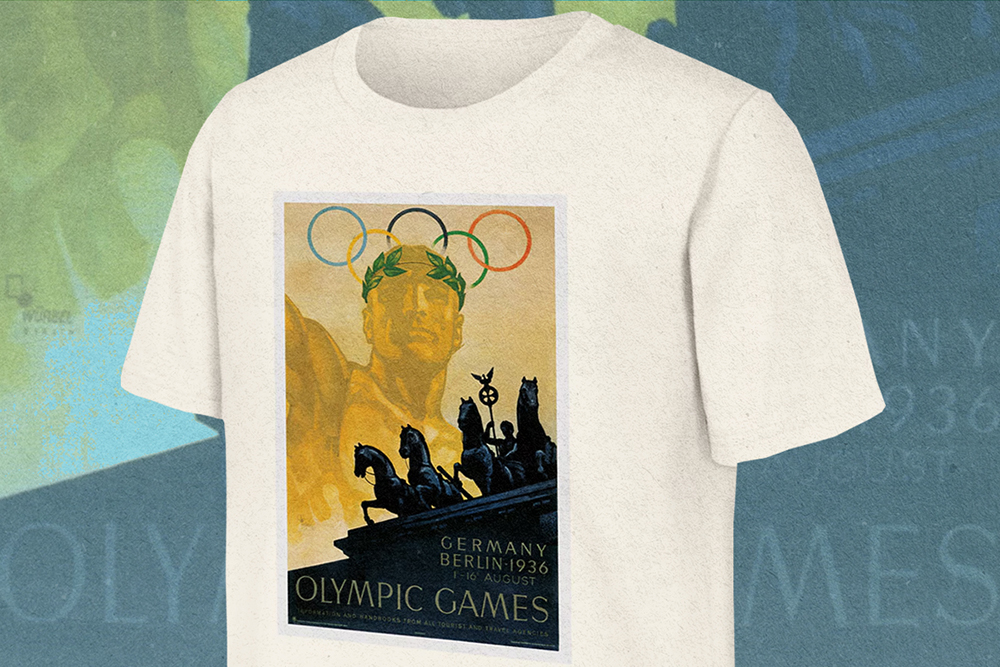
The artwork used on the shirt was designed by Austrian artist Franz Wurbel, with the Olympic rings hovering above a male figure with a wreath on his head. The top of Berlin’s Brandenburg Gate is shown below the figure with the words “Germany Berlin 1936 Olympic Games.”
The 1936 Games were staged at a time when Nazi-era ideology and rule within Germany was widespread. Hitler envisioned the Berlin Olympics as a way to push antisemitism and racial supremacy, while Jewish athletes where prohibit from competing in most event. However, Jesse Owens was a major highlight of the Games, winning four gold medals for the United States even as Hitler commonly referred to Black people as “non-humans.”
But by Saturday, the shirt was listed as “out of stock” on the Olympics store website while similar shirts depicting the artwork from the 1896 Athens Games, 1960 Rome Games, 1984 Los Angeles Games, 1988 Calgary Games and others were still available. On Sunday, the listing Berlin Games appeared to have been pulled from the website, with the original page redirecting to the homepage.
The IOC did not clarify whether sudden absence in the listing was due to calls for its removal but did note that a limited amount of each shirt were produced. Still the group has maintained that it has taken careful consideration over the use of any of its historical imagery, including materials from the 1936 Games.
“As part of this responsibility, the IOC maintains an Olympic Heritage Collection that reflects more than 130 years of Olympic art and design,” the IOC continues in its statement. “This collection presents assets such as emblems, pictograms, posters and mascots from every edition of the Games as historical artifacts. Maintaining a use of these historical elements also helps ensure they are not abused. In recent years, this stewardship has enabled the IOC to reduce widespread unauthorized third-party use of 1936 Games related assets.”