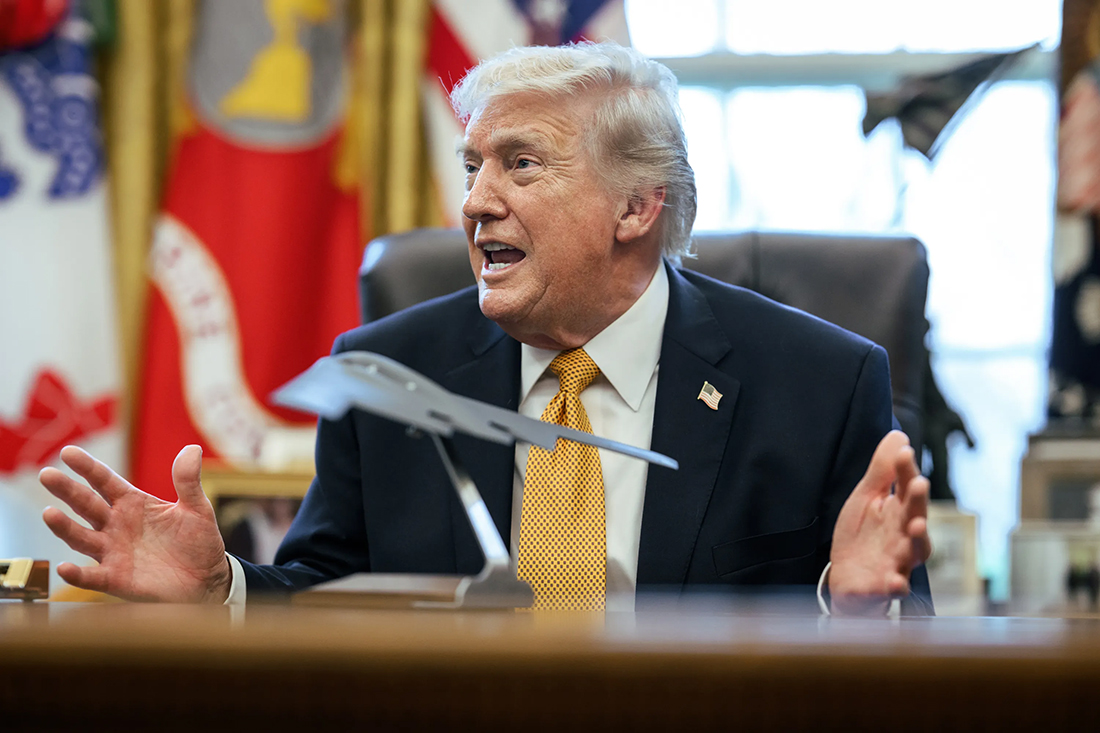
President Donald Trump signed an executive order on Friday setting limits on how long NCAA athletes can play sports in college and how many times they can transfer schools.
Under the order, athletes can compete for “no more than a five-year period” with just one eligible transfer before they graduate without having to sit out a season.
The move comes a month after Trump held a forum at the White House with around 50 of the most powerful figures in sports to discuss reform at all levels of college competition. The roundtable, “Saving College Sports” was aimed at building ordinance within the current NIL system, curbing unrestricted transfer portal protocols and stabilizing eligibility rules.
Trump’s newest executive order also looks to build a structure of preventing schools from eliminating scholarships, ensuring medical care for athletes, find a revenue sharing models that creates opportunities in women’s and Olympic sports along with ending “pay-for-play agreements” that funnel highly sought after athletes to institutions with seemingly endless resources.
“The resulting chaos is creating financial pressures that threaten to drain resources from all sports except football and basketball, and from many universities altogether,” a briefing on the report said. “While Congress is strongly encouraged to expeditiously pass legislation, further delay is not an option given what is at stake and the turmoil and instability currently facing universities across the nation.”
The changes in the order are set to take effect on August 1 and in a statement on Friday, NCAA president Charlie Baker acknowledged that the mandates outline by Trump were in line with reforms for athletes his organizations is seeking.
“The NCAA has modernized college sports to deliver more benefits for student-athletes, and the Executive Order reinforces many of our mandatory protections – including guaranteed health care coverage, mental health services, and scholarship protections,” the statement said. “This action is a significant step forward, and we appreciate the Administration’s interest and attention to these issues. Stabilizing college athletics for student-athletes still requires a permanent, bipartisan federal legislative solution, so we look forward to continuing to work alongside the Administration and Congress to enact targeted legislation with the support of student-athlete leaders from all three divisions.”
This is the second executive order from Trump that addresses collegiate sports after “Saving College Sports” was issued last July.
At the time, Trump sought tighter provisions that aimed to protect opportunities within college sports, limit when athletes could turn professional, restrict how boosters along with wealthy schools pay players under the guise of endorsement deals and preserving scholarships based on the revenue of each institution.
“A national solution is urgently needed to prevent this situation from deteriorating beyond repair and to protect non-revenue sports, including many women’s sports, that comprise the backbone of intercollegiate athletics,” Trump said in last year’s order.
Friday’s directive brings even more clarification with a deadline that matches with the start of the fall school year and when many sports seasons begin. However the order cannot simply overturn individual state laws that have already been put in place to specifically address allowing schools to funnel more resources into attracting big name talent. And athletes have long battled to be able to play after their eligibility expired.
And there are mandates in the order that contradict prior NCAA rule changes and court rulings. One key announced change on reducing transfers to just one will likely draw criticism from student athletes who now have several — and immediate — transfers under the current rules.
The NCAA has loosened its guidelines on transfers and eligibility but has also had to embrace the implementation of NIL after a 2021 Supreme Court ruling detailed that the organization could not place limits on how much an athlete can earn while in school. The ruling also noted that the NCAA is not exempt from antitrust laws and cannot direct its schools and conferences from setting caps on player earnings.
And while Trump’s latest order provides more clarity on his vision for clearer regulation in college sports, it will likely face opposition in court. Since late March, over 50 of his second-term executive order have either been overturned or temporarily blocked by federal courts and faced hundreds of lawsuits.