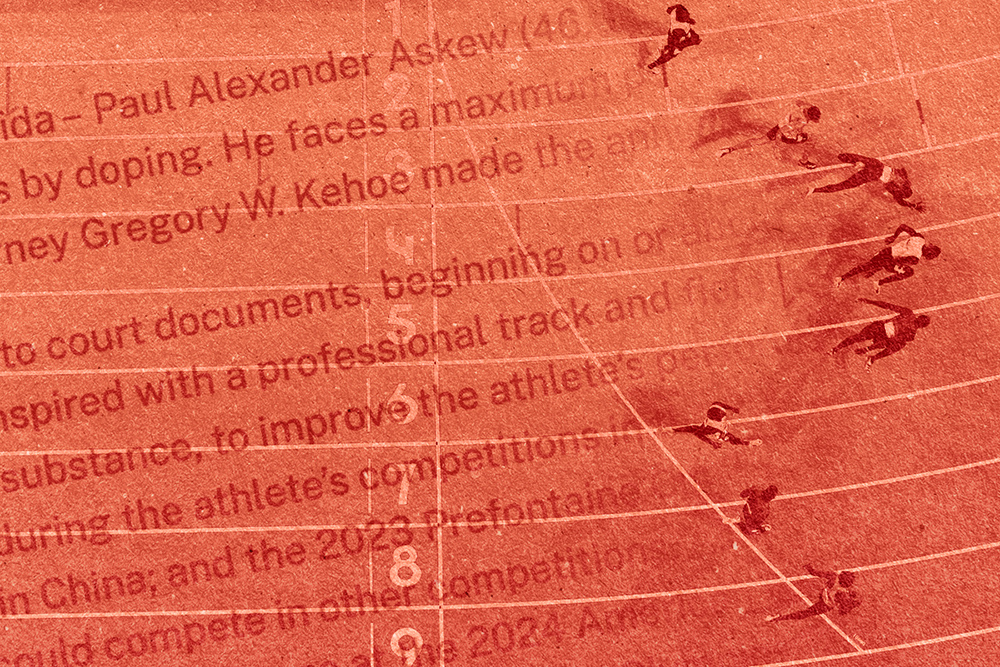
The U.S. Attorney’s Office, Middle District of Florida announced on Thursday that Paul Askew pleaded guilty on charges of conspiracy to influence international events like the 2024 Paris Olympics and 2023 Prefontaine Classic by proving athletes with banned substances.
Askew faces a 10-year federal prison sentence and according to court records, he “conspired with a professional track and field athlete” between July 2023 and January 2024 to supply the athlete with testosterone during periods of competition. The athlete was not named in the announcement but identified in several published reports as Marvin Bracy-Williams.
When the doping conspiracy was uncovered, Bracy-Williams had already competed in several track meets and investigators discovered a plot for him to use testosterone injections in time for the 2024 USA Track and Field Outdoor Championships, 2024 World Athletics Indoor Championships, 2024 U.S. Olympics Trials and the 2024 Paris Games. Askew is said to have coordinated all of those proposed uses of testosterone.
“Paul Askew’s guilty plea is another important win for clean sport and a clear reminder that those who conspire to dope athletes and corrupt major international competition will be held accountable under the Rodchenkov Anti-Doping Act,” U.S. Anti-Doping Agency CEO Travis T. Tygart said. “When powerful performance-enhancing drugs like testosterone are used to manipulate competition, it is the clean athletes who are robbed of a fair playing field, irreplaceable podium moments and the recognition they deserve.”
Bracy-Williams accepted a 45-month sanction in November from USADA after a whistleblower tip let investigators to collect an out-of-competition urine sample in early 2024. The sample tested positive for an anabolic agent and he was immediately provisionally suspended on February 5, 2024.
USADA said that Bracy-Williams tried to tamper with with the investigation, that was assisted by the Athletics Integrity Unit, U.S. Drug Enforcement Administration Orlando District Office. His positive test and attempted tampering are treated as a single violation under the World Anti-Doping Code and he admitted to using banned drugs and was given a one-year reduction for cooperating with the inquiry.
At last Sunday’s Enhanced Games, Bracy-Williams finished third in the men’s 100m in 10.39 and received $75,000. Fred Kerley won in 9.97 and Emmanuel Matadi was second in 10.05
Under the Rodchenkov Anti-Doping Act, which was signed into law in December 2020 by the first Trump administration, Askew faces penalties for individuals that target and conspire to supply athletes with illegal substances. The law is meant to find “organizers, coaches and enablers of doping” while not directly seeking to prosecute the athletes.
A sentencing date for Askew has not been revealed.