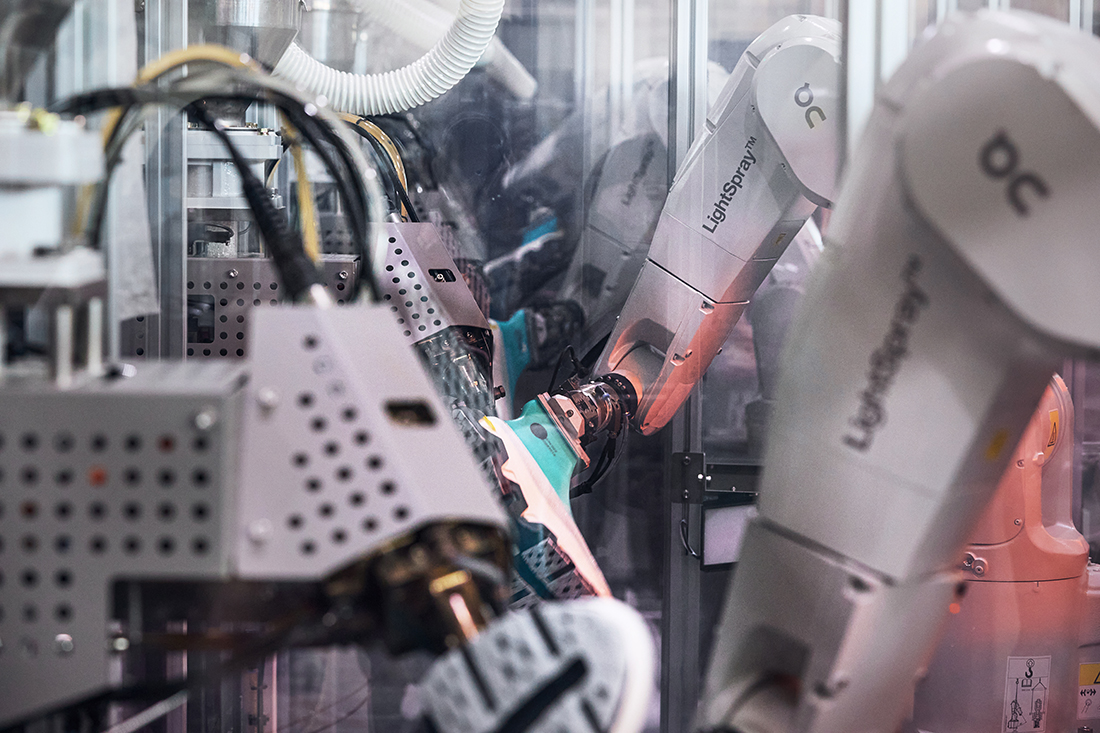
On unveiled its new South Korean factory on Wednesday in a move the company says will increase production 30-fold in 2026 of shoes built with its LightSpray technology.
The factory, near Busan, South Korea, is its second facility that will make the shoes in a process that involves spraying footwear uppers that are lightweight and durable. On also noted that the new factory will contain 32 fully automated robots, which is a significant boost from the four machines at its first LightSpray production center that opened last year in Zurich, Switzerland.
“The opening of our second LightSpray factory is a monumental milestone for us in mastering this advanced manufacturing process,” On co-founder Caspar Coppetti said. “I want to sincerely congratulate the tremendous effort and dedication of the entire team who made this possible. LightSpray is a pinnacle example of how On continues to innovate through Swiss Engineering, dramatically changing the way we can create high-performance shoes with unmatched efficiency, sustainability and performance results.”
Meanwhile, the additional robots will increase production capacity 30-fold this year as, the LightSpray Cloudmonster 3 Hyper will be the first shoe built at the South Korean factory, with the model debuting in North America on March 5, with a worldwide release on April 16.
“The beauty of LightSpray is that we can precisely program each robot, whether in Zurich or Busan, to execute precisely choreographed movements to craft each shoe’s unique look and feel,” On chief innovation officer Scott Maguire said. “The innovation remains distinctly On, distinctly Swiss—made for the world. South Korea represents the perfect territory to learn and implement learnings for our global expansion.”
On introduced its LightSpray technology in 2024 that featured sock-like uppers made with continuous thermoplastic polyurethane filament which joined to a midsole. The spraying process creates the upper without glue or thread, has no laces and can be completed in around three minutes. The material is designed for high performance, long mileage and is recyclable, according to the company.
The technique and use of robots occurred with no prior infrastructure as On claims the process was derived in-hour in a four-year process. The company said it hoped to utilize South Korea’s advanced standing in robotics and automation as a logical fit for its new facility and any processes it creates in Switzerland can deployed anywhere in the world — based on its guidelines.