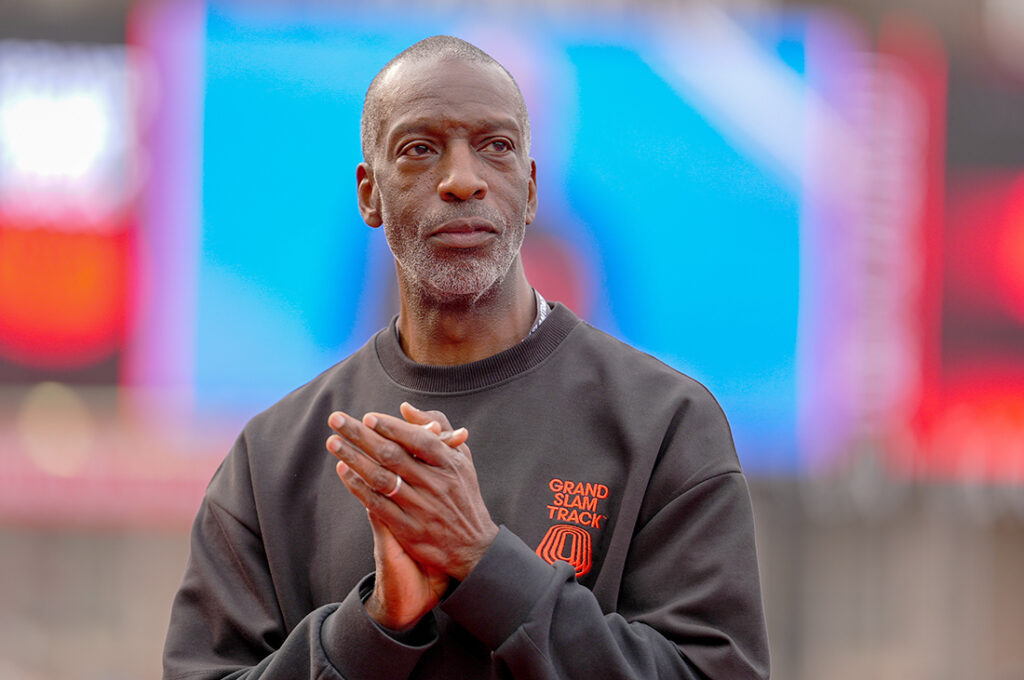
Grand Slam Track has filed for Chapter 11 bankruptcy and released a statement on Thursday that served as a update on its status as a league, finances, future plans and commitment to being transparent with its athletes.
The statement, titled “To The Grand Slam Track Community,” reiterated that financial issues surrounding a key investor hindered its ability to pay athletes and vendors.
“After the withdrawal of a committed investment earlier this year, we worked tirelessly to secure replacement funding, meet our obligations, and keep GST moving forward.”
The statement also was clear that a “reset” was needed to keep the league alive and allow for future seasons to occur — and that the league will not shut down or stray from its long term vision of pushing track globally.
However, the statement also confirmed that it is in the process of “court-supervised proceedings” as word spread last month that it asked vendors to accept 50 percent of owed payments in order for the league to survive.
“With every alternative fully explored, moving into a court-supervised reorganization — which is what GST did today became the clearest path to protect our community and our mission,” the statement said.
Based on a public bankruptcy filing in Delaware, the league claims to have $0-50,000 in assets, 200 and 999 creditors and between $10,000,001 and $50 million in liabilities. The filing also notes that Grand Slam Track does not have possession of “real property.” Meanwhile, the company appeared to be operating with a trimmed down staff after another round of layoffs, according to Front Office Sports.
According to its public bankruptcy filing, Grand Slam estimates it has under $50,000 in assets, between $10,000,001 and $50 million in liabilities, and between 200 and 999 creditors. The document was filed Thursday and signed by Johnson, league president and COO Steve Gera, and J. Rudy Freeman.
Still, the league continues to face mounting setbacks that took another turn when a law firm retained by the league contacted vendors and made it clear that they would all need to agree to the half payment proposal in early December to receive any funds.
World Athletics swiftly rejected the offer sent from attorneys at Levene, Neale, Bender, Yoo & Golubchik LLP and the governing body as adamant that it wanted to Grand Slam Track to first resolve its debts to its athletes. World Athletics was reportedly owed $40,000 and has been monitoring widespread news to of the league’s financial issues since its final scheduled meet was cancel weeks before it was to be staged in June.
“That’s why we have done everything possible to address our financial challenges.” Thursday’s statement from the league said. “After the withdrawal of a committed investment earlier this year, we worked tirelessly to secure replacement funding, meet our obligations, and keep GST moving forward.”
And while league founder Michael Johnson has been open about the state of the venture, he only became more vocal once rumors spread that there were financial hardships in late June.
But by that time, after the Los Angeles meet cancelation, athletes and their representatives reached out to World Athletics and asked for assistance since as nearly $13 million in appearance fees and cash prizes had not been paid dating back to the first meet in Kingston, Jamaica in April — meaning that money problems were present from the start.
Grand Slam Track was announced in 2024 and pulled the attention of the sport when Sydney McLaughlin-Levrone was revealed as the first signing to its roster.
Johnson spoke on raising the quality of competition and promised cash prizes that exceeded other meets and event Diamond League payouts. Grand Slam Track event category winners would receive $100,000 while the eighth-place finishers got $10,000 — part of nearly $13 million in compensation that was announced as set aside for athletes.
With a reported $30 million in financial backing “from investors and strategic partners” and with Winners Alliance spearheading the funding efforts, the league appeared stable event as the Kingston event in April had low turnout. It quickly rebounded with the Miami-area meet in May, drawing sellout crowds but shortly after the event the league announced it would trim its usual three day schedule to just two days for its third meet in Philadelphia.
But after an interview in July and and open letter in August addressing the league’s setback, Johnson released a statement in October that spoke about Grand Slam Track’s future even as athletes and vendor still awaited payment.
“Today is the beginning of Grand Slam Track’s reboot,” the message said. “We apologize for frustrations and hardships caused by the payment delays to date. Over the next 60 days, we will be working hard to make things right with everyone who helped make 2025 a success, to best position GST for 2026 and beyond. This is a critical step in that delicate and difficult process, but know there is a path. Our appreciation of your grace and support as we walk that path cannot be overstated.”