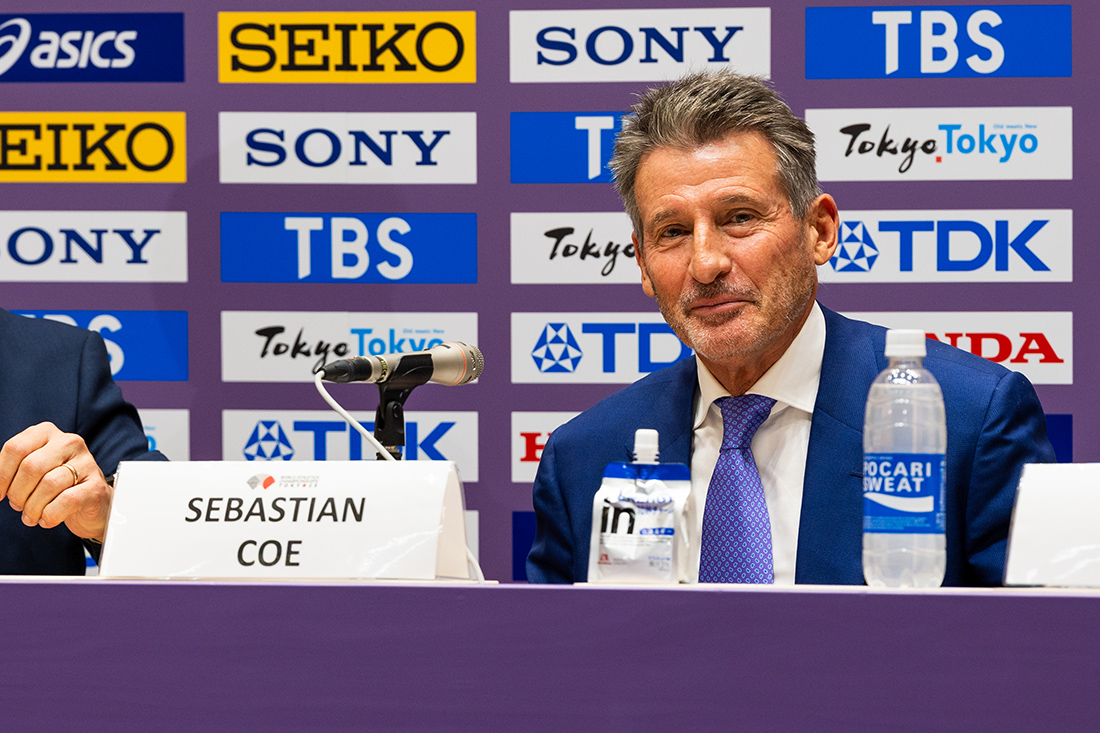
World Athletics president Sebastian Coe said that governing body has a responsiblity “police the calendar” following Grand Slam Track’s move to file for bankruptcy.
In his year-end call with the media on Tuesday, Coe recapped a busy track and field season but warned that even if it could pay its debts, Grand Slam Track might not be allowed to return to the sport’s schedule of events next year.
“We welcome innovation into the sport,” Coe said. “We welcome fresh investment, but it has to be underpinned by a sustainable, solid financial model executed and delivered on behalf of the athletes.”
Coe was also clear that World Athletics was continuing to monitor the fallout of Grand Slam Track’s bankruptcy proceedings. The league filed amended documents on Monday that detail the nature of its debts with Sydney McLaughlin-Levrone and Gabby Thomas among its top athletes who are now creditors.
The league filed for Chapter 11 bankruptcy protection last week as part of a measure to restructure its debts and try to remain operational. Last month, Grand Slam Track asked its creditors to accept just half of owed payments in unison by December 5 in order to help the league stay afloat. The payment offer was rejected by some, with World Athletics among those who refused to be paid partially.
When asked if World Athletics could prevent Grand Slam Track from staging a second season in 2026, of it resolved its financial issues, Coe was was mindful about his response but alluded to the governing body’s influence in the sport.
“We create the calendar. We have to police the calendar,” Coe said. “And we have to make sure that when there are fresh events, that they come to the table with the kind of credentials and assets that I talked about.”
Grand Slam Track held its inaugural meet Kingston, Jamaica in April, after offering the largest prized payouts in the sport. The Kingston meet faced initial criticism due to low turnout but rebounded with events in Miami and Philadelphia in May. A fourth, and final, showcase scheduled for June in Los Angeles was abruptly canceled and rumors swirled around the league possibly facing financial issues.
In the months following the end of Grand Slam Track’s season some of its athletes and their representatives even contacted World Athletics for guidance since it was revealed that payments dating back to the Kingston meet had not been issued.
What follows in the coming months for the league during the bankruptcy process will draw the attention of World Athletics as it may likely face a difficult road regaining the trust of fans of the sport — and athletes.
Meanwhile, Coe is focused on the continued work that will lead up to the inaugural Ultimate Championship next September in Budapest during a time when there are no Olympics or world championships on the calendar. World Athletics has imagined the event as an innovated season-ending format that only features semifinals and finals that will draw the same top talent as a Diamond League meet.
“Over the next few years, there are going to be lots of different and new things and I welcome that,” Coe said. “But it has to be suffused in a realistic proposition that is fireproof. It’s got to be sustainable.”
Event winners from the 2024 Olympics, 2025 World Championship and 2026 Diamond League are eligible for automatic qualification for the meet, which will follow a condensed three day schedule.
“This new format matters, and it’s not just because of the historic $10 million prize pot – that is important – we really do want something that reads all action and no filler,” Coe said. “It’s three hours a night over three nights, it’s unashamedly aimed at increasing our footprint across broadcastable offerings and we’ve really re-imagined the format to eliminate down time.”